
Ctrl K
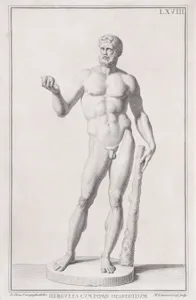
**Marcantonio Corsi (also associated with Giovanni Domenico Campiglia)** was an Italian engraver active in the mid-eighteenth century, best known for his precise copperplate engravings that documented classical sculptures and artworks in Florentine collections. Working primarily in the 1730s and 1740s, Corsi specialized in reproductive prints that faithfully translated the drawings of prominent artists into detailed engravings for scholarly publications.
His most notable collaboration was with the Florentine painter and draughtsman Giovanni Domenico Campiglia (1692–1775), whose preparatory drawings Corsi engraved for major projects such as the *Museum Florentinum*. A prime example is his 1734 engraving of the *Statue of Hercules* (Plate LXVIII), which captures the monumental sculpture with remarkable clarity and fidelity to Campiglia’s original design. These prints served both artistic and documentary purposes, preserving images of important antiquities for scholars and collectors across Europe.
Corsi’s work reflects the meticulous engraving traditions of eighteenth-century Italy, emphasizing line work and tonal subtlety to convey three-dimensional form on the printed page. Though biographical details about his training remain limited, his output aligns with the flourishing print culture centered in Florence under Medici patronage, where artists like Campiglia supplied designs for ambitious illustrated volumes.
Today, Corsi’s engravings are valued for their contribution to art-historical documentation. The single work in the museum’s collection—the Hercules engraving—exemplifies his skill in bridging painting, sculpture, and printmaking, ensuring that the visual legacy of classical art endured through the printed medium. His precise technique continues to inform our understanding of how eighteenth-century artists disseminated knowledge of ancient and Renaissance masterpieces.
All 1 artworks loaded