
Ctrl K
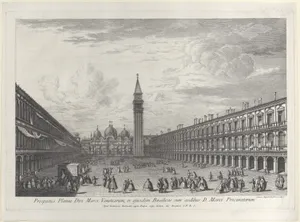
**Michele Marieschi (also known as Michele Giovanni Marieschi or Michiel; 1710–1744)** was an Italian painter and engraver active in Venice, renowned for his vedute (city views) and architectural capricci that captured the city’s luminous canals, palaces, and bustling life. Born in Venice as the son of an engraver, he trained likely under the history painter Gaspare Diziani or possibly Canaletto, or both, and drew early inspiration from stage design. He may have spent time in Germany working as a scene painter before returning to Venice by 1731, where he is recorded creating theatrical effects.
Marieschi worked in the vibrant Venetian tradition of view painting, influenced by Marco Ricci, Luca Carlevarijs, and especially Canaletto’s commercial success in the genre. He began producing imaginary capricci before shifting toward more topographically accurate vedute, employing lively brushwork, exaggerated perspectives, and a fresh, theatrical sense of space derived from his scenographic background. Registered in the Venetian painters’ guild (Fraglia de’ Pittori) from around 1735 to 1741, he gained a notable patron in the collector Johann Matthias von der Schulenburg, who acquired multiple canvases from him in the late 1730s.
Among his major works are numerous views of Venice, including scenes of the Bacino di San Marco and the Rialto Bridge, as well as the important series of 21 engravings published in 1741–42 under the title *Magnificentiores Selectioresque Urbis Venetiarum Prospectus*. He died young in Venice on 18 January 1744 at around age 33. His most gifted pupil and follower was Francesco Albotto, and his dynamic style exerted a considerable influence on the later vedutista Francesco Guardi.
Marieschi’s relatively brief career helped bridge the theatrical and topographical strands of 18th-century Venetian art, leaving a legacy of energetic, atmospheric views that continue to define the city’s visual identity in museum collections worldwide.
All 1 artworks loaded