Ctrl K
1535–1585
**Muhammad al-Qivam al-Shirazi (also known as Muhammad ibn Taj al-Din Haidar Muzahhib Shirazi) was an Iranian calligrapher and illuminator active in the mid-to-late sixteenth century.** Born around 1535 and active until approximately 1585, he worked primarily in Shiraz during the Safavid period, contributing to the production of luxurious illustrated manuscripts. His career centered on the collaborative creation of Persian literary classics, where he applied both calligraphic precision and illuminated decoration.
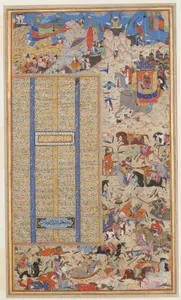
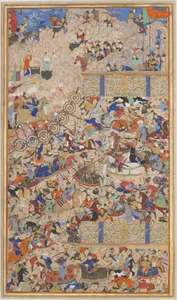
He specialized in the intricate arts of the kitabkhana (manuscript workshop), producing work in the established Shiraz tradition of Persian miniature painting and illumination. His contributions appear in a major Shahnama (Book of Kings) manuscript dated between 1562 and 1583, a project that exemplifies the vibrant narrative illustration and elegant nastaʿlīq script characteristic of Safavid book arts. In this volume, he is credited in one capacity as calligrapher and in another as illuminator, highlighting the specialized division of labor in manuscript production.
Among his documented works are two folios preserved in the Metropolitan Museum of Art: “Battle Between Iranians and Turanians,” a dynamic battle scene rendered in ink, opaque watercolor, and gold on paper, and an accompanying page of calligraphy from the same Shahnama. These pieces demonstrate his skill in combining textual elegance with vivid historical imagery drawn from Firdausi’s epic.
Though biographical details beyond his professional activity remain limited, al-Qivam al-Shirazi’s output reflects the high level of artistic refinement achieved in sixteenth-century Shiraz workshops. His manuscripts helped sustain and transmit the visual language of Persian epic literature, influencing later generations of calligraphers and painters working in the Safavid and subsequent traditions.