
Ctrl K
1792–1865
**Otto Friedrich Magnus, Count von Baudissin (1792–1865)**
Otto Friedrich Magnus, Count von Baudissin, was born on July 5, 1792, in Knoop near Kiel (then part of Danish Holstein), into a noble family of Upper Lusatian origins that had settled in Schleswig-Holstein. The son of Count Carl Ludwig von Baudissin and Countess Sophie Luise Charlotte von Dernath, he grew up amid military traditions, entering Danish service early and rising to major by 1848. During the Schleswig-Holstein War (1848–1851), he defected to fight against the Danes, earning promotion to colonel for heroic stands at battles like Bau, Kolding, and Idstedt, where he was severely wounded. Discharged in 1851, he retired to Hamburg and Dresden, devoting his later years to artistic pursuits.
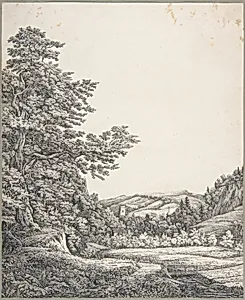
As a Liebhabermaler—an accomplished amateur artist—Baudissin produced detailed drawings capturing landscapes from his travels and surroundings, working primarily in pen and black ink over graphite. His subjects included Italian motifs encountered on journeys, Danish vistas from his homeland, and prospect views of German scenery. Notable surviving works feature *Southern German Landscape* (ca. 1800–1865), held by The Metropolitan Museum of Art, depicting a romanticized vista with meticulous linework, and *Thal der Schwarzen Bockau* (Erzgebirge), a valley scene from the Ore Mountains that appeared at auction. These pieces reflect a topographic precision suited to an officer's eye, blending Romantic sensitivity to nature with documentary clarity, though no formal training or mentors are recorded.
Baudissin died on June 25, 1865, in Teplitz (now Teplice, Czech Republic), after settling in Dresden. His artistic legacy endures modestly through institutional collections and occasional sales, underscoring the era's tradition of noble dilettantes who enriched visual culture beyond professional academies. While his military exploits dominate historical accounts, his serene landscapes offer a poignant counterpoint, inviting viewers to trace the contours of a peripatetic life shaped by duty and discovery.