
Ctrl K
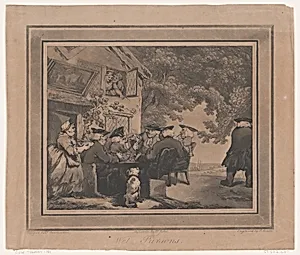
**Peter Simon (c. 1764–1813)**
Born in London around 1764, Peter Simon, also known as John Peter Simon or Jean-Pierre Simon, emerged as a leading stipple engraver during the late Georgian era. He entered the Royal Academy Schools on December 31, 1778, at a remarkably young age, and studied under the engraver Victor Marie Picot. This rigorous training honed his mastery of stipple technique—a method using dotted lines to create tonal effects and subtle gradations ideal for reproductive prints. Simon's early career flourished in London, where he became a sought-after collaborator for publishers like John Boydell, translating the paintings of prominent British artists into exquisite engravings. He later mentored engraver Jean Godefroy, passing on his expertise in this delicate medium.
Simon's artistic style epitomized the reproductive printmaking tradition of the Boydell Shakespeare Gallery, a monumental project that illustrated Shakespeare's plays through collaborations between painters and engravers. Among his standout works are *As You Like It, Act 5, Scene 4* after William Hamilton (1792), capturing the pastoral revelry with luminous stipple effects; *Falstaff in the Buck Basket* from *The Merry Wives of Windsor, Act 3, Scene 3* after Matthew William Peters (1793); *The Winter's Tale, Act II, Scene III* after John Opie (1793); and *A Midsummer Night's Dream, Act IV, Scene I* after Henry Fuseli (1796). He also engraved scenes after Joshua Reynolds, such as the iconic *Angels' Heads*, and literary illustrations like *Tom Jones* after John Downman for Boydell editions. These prints not only disseminated high art to a wider audience but showcased Simon's ability to preserve the original paintings' emotional depth and color through monochrome dots.
In 1802, Simon relocated to Paris, where he continued engraving after artists like Carle Vernet and John Flaxman, contributing to French publications. Retaining his British nationality amid Napoleonic tensions, he died on November 15, 1813, at age 49; his property was seized as that of an enemy alien, ironically preserving his archives. Simon's legacy endures as a bridge between British Romantic painting and print culture, his stipple engravings elevating Shakespearean imagery into enduring icons of 18th-century visual storytelling. Though less celebrated than painters like Reynolds or Fuseli, his technical brilliance made their visions accessible, influencing generations of engravers and collectors.