
Ctrl K
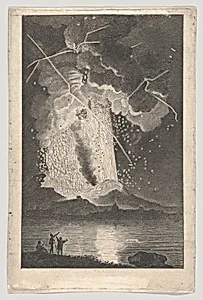
**Pierre-Jacques Volaire (1729–1799/1802?)** was a French painter renowned for his dramatic depictions of Mount Vesuvius in eruption. Born in Toulon to a family of artists—his father served as the city’s official painter—he began his career under the tutelage of the celebrated marine painter Claude-Joseph Vernet. From 1754, Volaire worked as Vernet’s assistant for eight years, absorbing skills in landscape and seascape painting while Vernet executed his famous *Views of the Ports of France* series for Louis XV.
After leaving France for Rome in 1764, Volaire settled permanently in Naples in 1769. There he developed his signature specialty: vivid nocturnal scenes of Vesuvius erupting, which he painted at least thirty times. These works catered to British and European tourists on the Grand Tour, who sought dramatic souvenirs of their visits to the active volcano and the recently excavated sites of Pompeii and Herculaneum. His paintings, such as *The Eruption of Vesuvius* (1771, Art Institute of Chicago) and *The Eruption of Vesuvius, A View of Naples Beyond* (ca. 1776, Metropolitan Museum of Art), capture the sublime terror of nature with glowing lava flows, billowing smoke, and terrified onlookers against the night sky.
Volaire’s style aligned with the emerging Romantic interest in the sublime, blending precise observation from his repeated ascents of the volcano with theatrical lighting effects. His Vesuvius scenes influenced later artists including Joseph Wright of Derby, Philipp Hackert, and Charles LaCroix de Marseille. Though details of his personal life remain sparse, his prolific output and popularity among collectors ensured that examples of his work are preserved in major institutions worldwide, including the Getty Museum, the North Carolina Museum of Art, and European collections. Volaire’s legacy endures as a key chronicler of eighteenth-century Neapolitan spectacle and the Grand Tour era.