Ctrl K
**Pierre de La Mésangère (1761–1831)** was a French writer, editor, and publisher whose work profoundly shaped the visual record of early nineteenth-century Parisian fashion and decorative arts. Born Pierre Antoine Leboux de La Mésangère on June 23, 1761, in Pontigné, he trained as an Oratorian priest and served as professor of belles-lettres and philosophy at the Collège Henri-IV in La Flèche. The Revolution closed the college, prompting his move to Paris, where he supported himself through writing and, from 1799 until his death on February 22, 1831, directed the influential *Journal des dames et des modes*.
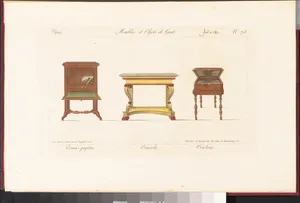
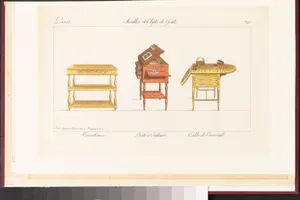
Although not a professional painter by training, La Mésangère produced or oversaw numerous drawings and designs that entered museum collections, including delicate watercolors and preparatory studies executed in black and red chalk heightened with white. His editorial projects emphasized hand-colored engravings that captured the Empire style’s elegance and eccentricity. Key publications include the long-running fashion journal, the multi-volume *Meubles et Objets de Goût*, and illustrated costume albums such as *Costumes des femmes de Hambourg, du Tyrol...* (1827) and observations on *Le Bon Genre* caricatures. These works paired his own commentary with designs by artists such as Louis-Marie Lanté, engraved by Gatine and others.
La Mésangère’s legacy lies in his meticulous documentation of contemporary taste. Through the *Journal* and related volumes he preserved the fleeting details of dress, furniture, and social custom during the Napoleonic era and the Restoration, creating an indispensable visual archive for art historians and costume scholars. His eccentric personal habits—amassing vast quantities of clothing and small change for charity—were noted by contemporaries and add color to the portrait of this serious yet observant cleric-turned-publisher. Today his contributions are represented in major institutions, including the British Museum, the National Gallery of Art, and the Metropolitan Museum of Art, where his engravings and drawings continue to illuminate the material culture of his time.
All 2 artworks loaded