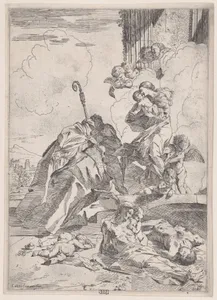
Pietro Testa, born in Lucca around 1611 and known as *il Lucchesino*, emerged as a pivotal figure in the High Baroque era, particularly renowned for his mastery of printmaking and drawing in Rome, where he spent most of his career until his untimely death in 1650. Moving to the Eternal City early in life, Testa navigated the vibrant artistic scene with ambition. Sources differ on his precise training: one account notes his brief stint in Pietro da Cortona's studio, from which he was reportedly ejected in 1631, while others confirm he studied under Pietro Paolini in Lucca or worked under Domenichino, executing commissions for the influential patron Cassiano dal Pozzo. These experiences honed his technical prowess, blending rigorous draftsmanship with imaginative flair, and he forged close friendships with Nicolas Poussin and Francesco Mola, enriching his intellectual circle.
Testa's artistic style epitomized the High Baroque's dramatic intensity, yet his etchings and drawings often veered into the fantastical, incorporating drypoint techniques for intricate textures. Evoking the capricious visions of Jacques Callot, the embellished lyricism of Giovanni Benedetto Castiglione, and even foreshadowing the visionary intensity of William Blake, his works transcended mere reproductive prints to become independent masterpieces. He worked within the Roman Baroque tradition, emphasizing mythological and sacrificial themes with a blend of classical poise and ethereal invention. Notable among his output is *The Sacrifice of Iphigenia*, an etching whose composition later inspired Giambattista Tiepolo's fresco at Villa Valmarana Ai Nani in Vicenza, underscoring Testa's enduring influence on later generations.
Though his life was cut short—possibly by drowning in a fit of melancholy—Testa's legacy endures through collections at institutions like the J. Paul Getty Museum, the Metropolitan Museum of Art, and the National Gallery of Art, where over a dozen of his works are preserved. His innovative prints elevated etching to a fine art, bridging disegno and fantasia in ways that captivated collectors and artists alike. Testa's oeuvre, though not vast in paintings, revolutionized graphic arts, offering a window into the Baroque imagination's boundless depths.
(Word count: 348)
All 1 artworks loaded
