Ctrl K
François Antoine Pfeiffer was a distinguished French porcelain decorator who worked at the prestigious Sèvres Porcelain Manufactory from 1771 to 1800. Early life and training are not well documented, but Pfeiffer quickly established himself within the royal manufactory's rigorous tradition of enamel painting on hard-paste porcelain. Founded in 1740 at Vincennes and relocated to Sèvres in 1756 under Louis XV, the factory held a royal monopoly on soft-paste porcelain before innovating with hard-paste in the 1760s, renowned for its vibrant enamels, intricate gilding, and luxurious grounds imitating lacquer, hardstones, and Oriental motifs.
Pfeiffer specialized in floral motifs and decorative patterns, contributing to the Neoclassical elegance that defined late eighteenth-century Sèvres output. His delicate flower painting and laurel swags adorned borders and reserves, often enhancing pieces with gilded scrollwork amid rich grounds like black lacquer or porphyry. Active during the French Revolution, when aristocratic patronage plummeted and the factory faced economic ruin, Pfeiffer's work exemplifies Sèvres' resilience, producing innovative luxury items amid turmoil.
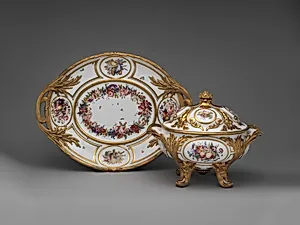
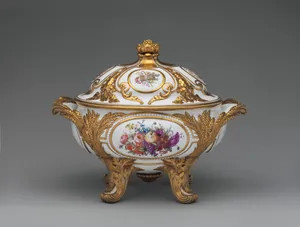
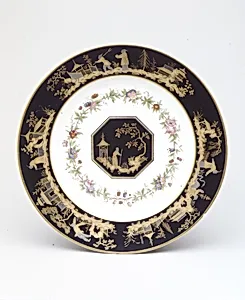
Among his verified contributions are the finely painted borders on an écuelle ronde (round bowl and cover) dated 1781, featuring dolphin handles and commemorating the birth of the Dauphin Louis Joseph; a 1791 plate with black ground chinoiserie scenes in gold; and flower decoration on a Neoclassical ewer and basin from 1795, mimicking hardstone surfaces. He also collaborated on a tureen with cover (ca. 1777–85) alongside decorators Nicolas Sinsson and gilder Henri-François Vincent, and a stand with similar partners.
Pfeiffer's legacy endures in major collections like the Metropolitan Museum of Art and Victoria & Albert Museum, where his precise, naturalistic flowers embody Sèvres' pinnacle of technical virtuosity and aesthetic refinement. Though individual biographies remain sparse, his marked pieces highlight the collaborative genius of the manufactory, which thrives to this day as a national treasure of French decorative arts.