Ctrl K
**A member of the Sangallo family (Florence, ca. 1530–1545)** was an Italian draftsman and architectural illustrator active in Renaissance Florence. Part of the renowned Sangallo lineage of architects, sculptors, and military engineers descended from the woodworker Francesco Giamberti, this artist belonged to a dynasty that included Giuliano da Sangallo (c. 1445–1516), Antonio da Sangallo the Elder (c. 1455–1534), and Antonio da Sangallo the Younger (1484–1546). The family’s deep engagement with classical antiquity, particularly the writings of the Roman architect Marcus Vitruvius Pollio (active late 1st century BCE), shaped their work across generations.
Trained within the family workshop tradition that emphasized precise draftsmanship, classical proportions, and the study of ancient ruins, this artist worked in the Florentine Renaissance school. Their drawings reflect the influence of earlier Sangallo masters such as Giuliano, whose measured studies of Roman temples informed later interpretations. The style features expressive pen work, shorthand figure notation, and a focus on interpretive reconstructions of Vitruvian principles, blending archaeological accuracy with imaginative Renaissance theory.
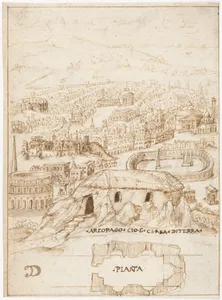
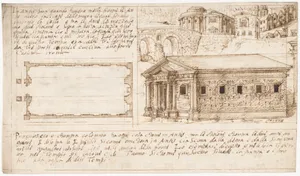
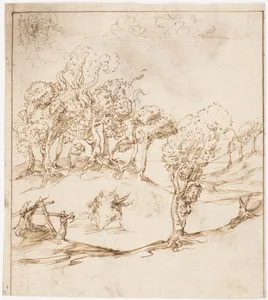
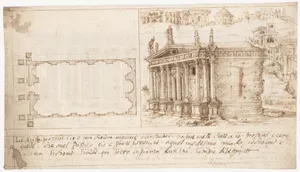
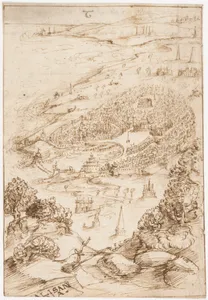
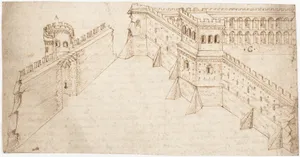
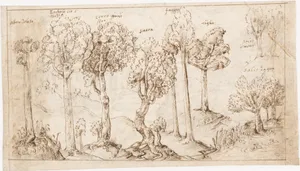
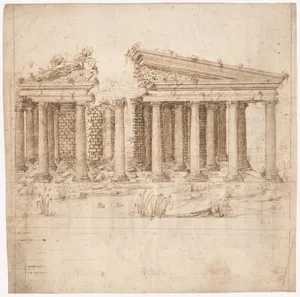
Among their known contributions are a series of pen-and-ink drawings (c. 1530–1545) intended for an ambitious but unfinished Italian edition of Vitruvius’s *De architectura*. These include elevations of ruined Roman temples and basilicas, such as a front elevation inspired by Giuliano da Sangallo’s studies and a nave elevation possibly depicting the Basilica Giulia. The sheets demonstrate both technical skill and a commitment to reviving ancient architectural knowledge through visual commentary.
As part of the Sangallo family’s broader legacy, this artist helped sustain Florence’s central role in Renaissance architectural discourse. Their Vitruvian illustrations extended the family’s multi-generational dialogue with classical sources, influencing subsequent generations of architects and theorists who sought to codify and reinterpret antique principles for contemporary practice. Though the individual remains unidentified, their work exemplifies the collaborative, antiquity-obsessed culture of the Sangallo workshop.