
Ctrl K
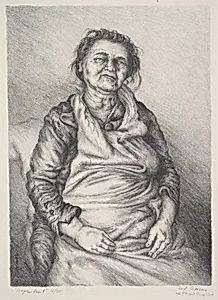
**Sol Carson (1917–2017)** was a prolific American artist whose career bridged the gritty social realism of the Great Depression era and the vibrant landscapes of his later years. Born Sol Kent Carson on June 7, 1917, in Philadelphia, Pennsylvania, to Russian immigrant parents originally surnamed Karsonsky, he immersed himself in art from a young age. He attended the Tyler School of Fine Arts and studied under Boris Blai, the founding dean of the School of Art, honing his skills in printmaking and painting. As a student in the 1930s, Carson launched his professional career with the Works Progress Administration (WPA), where he worked as a printmaker and oil painter alongside fellow artists, mastering his craft amid the economic hardship of the time.
Carson's WPA-era lithographs captured the human toll of the Depression with unflinching empathy, focusing on everyday struggles through portraits and genre scenes. Notable works include *Dependent* (ca. 1935–43), a poignant lithograph now in the Metropolitan Museum of Art depicting vulnerability and need; *Meal Time*, *The Etcher* (ca. 1940, possibly a self-portrait from Philadelphia's WPA Print Workshop), *Sleeping Head*, and *Tired Out*. These pieces, often drawing from Jewish heritage and African American culture, reflect the social realist tradition of the Federal Art Project, emphasizing dignity amid despair.
After the WPA, Carson advanced to Director of Visual Education at Temple University, shaping generations of artists over many years before relocating to California in 1962. There, in Los Gatos, he continued painting fluid landscape oils alive with dramatic color contrasts evoking nature's dynamism, while also pursuing poetry—publishing *Come Say Hello Before I Go* in 2012, dedicated in part to his late wife, Thelma. As a retired art professor who lived to 100, Carson's legacy endures in his WPA prints preserved in major collections and his enduring commitment to art as a mirror of human experience, from urban hardship to natural splendor.