
Ctrl K
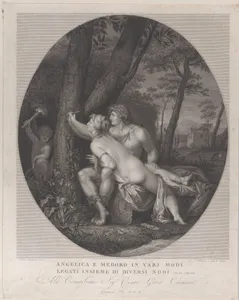
**Teodoro Matteini (1753/1754–1831)** was an Italian painter renowned for his historical and religious subjects rendered in a refined Neoclassical style. Born in Pistoia, he received his earliest training from his father, the decorative painter Ippolito Matteini. He later moved to Rome under patronage, where he worked in the studios of Domenico Corvi and Anton Raphael Mengs, absorbing the classical ideals that would define his mature work.
Matteini was active across several Italian cities, including Rome (where he contributed to San Lorenzo in Lucina), Bergamo, Milan, and ultimately Venice. In 1802 he was elected professor of painting at the Accademia di Belle Arti in Venice, later teaching design and helping restore the academy’s important collection of stucco and terracotta models. His best-known painting, *Angelica and Medoro* (late 18th century), exemplifies his elegant, narrative approach and was widely reproduced through engravings.
A dedicated teacher, Matteini influenced a generation of artists that included Francesco Hayez, Cosroe Dusi, and others who carried Neoclassical principles into the 19th century. His portraits and large-scale compositions remain in collections such as the Gallerie dell’Accademia in Venice, underscoring his lasting contribution to Italian academic painting.
**Giovanni Folo (1764–1836)** was an Italian engraver of the Neoclassic period, celebrated for his reproductive prints after major masters. Born in Bassano del Grappa, he first studied painting in Venice with Giulio Golini and Giovanni Battista Mengardi before moving to Rome in 1781. There he trained under Giovanni Volpato and later adopted the refined manner of Volpato’s pupil Raffaello Morghen.
Folo gained fame for his engravings after paintings and sculptures by Raphael, Michelangelo, Titian, Poussin, Canova, Thorvaldsen, and contemporary Italian artists. He became a member of Rome’s Accademia di San Luca and was elected an Honorary Academician of the National Academy of Design in New York. One notable collaboration linked him directly to Teodoro Matteini: Folo produced an engraving after Matteini’s *Angelica and Medoro*, helping disseminate the painter’s composition across Europe.
Active until his death in Rome, Folo played a vital role in the visual culture of Neoclassicism by translating celebrated works into widely circulated prints that shaped public taste and artistic education throughout the late 18th and early 19th centuries.
All 1 artworks loaded