Ctrl K
**Thomas Rowlandson** (1757–1827) was a leading English artist and caricaturist of the Georgian era, celebrated for his sharp political satire, lively social observations, and prolific output of drawings, prints, and book illustrations. Born on 13 July 1757 in London’s Old Jewry to a family in the textile trade, he grew up amid financial instability after his father’s bankruptcy. He attended the Soho Academy run by Dr. Cuthbert Barwis before entering the Royal Academy Schools around 1772, where he studied for several years. He also spent time in Paris, possibly studying under sculptor Jean-Baptiste Pigalle, which helped refine his skills in figure drawing and caricature.
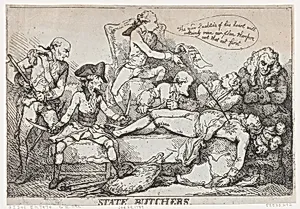
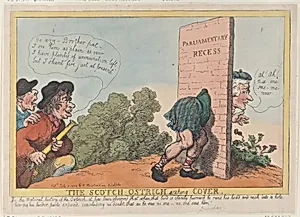
Rowlandson began his career as a portrait painter and exhibited at the Royal Academy, but he soon turned to caricature and humorous illustration, influenced by contemporaries such as James Gillray and Henry William Bunbury. His distinctive style featured fluid reed-pen outlines delicately washed with watercolor, often etched and aquatinted for reproduction. He excelled at capturing the bustle of London life—pleasure gardens like Vauxhall, election crowds, medical quacks, and everyday characters—while also producing political satires targeting figures such as William Pitt the Younger, Napoleon, and the Duchess of Devonshire. A notable example in the museum’s collection is his etching of Henry Dundas, 1st Viscount Melville, reflecting his engagement with contemporary political subjects.
Among his most famous works are the collaborative *Tour of Dr. Syntax* series (beginning 1809–1812) with writer William Combe and publisher Rudolph Ackermann, as well as *The English Dance of Death* (1815–16) and illustrations for authors including Smollett, Goldsmith, and Sterne. He also created erotica for private clients and helped popularize the personification of John Bull. Rowlandson’s output was enormous—estimated in the thousands of drawings—and he worked across media, often for the print market.
Rowlandson died in London on 21 April 1827. His legacy endures as one of Britain’s greatest visual chroniclers of the late eighteenth and early nineteenth centuries, whose witty, humane depictions continue to illuminate Georgian society, manners, and politics for modern viewers. His works are held in major collections worldwide, including the two pieces in this museum.
All 2 artworks loaded