
Ctrl K
Thomas Sheraton, born in 1751 in Stockton-on-Tees, County Durham, was the son of a local schoolmaster also named Thomas. Receiving a modest education, he apprenticed to a local cabinetmaker and worked as a journeyman, honing his skills in draughtsmanship and carving. A devout Baptist, Sheraton authored religious tracts, including *A Scriptural Illustration of the Doctrine of Regeneration* (1782), before marrying Margaret Mitchinson in 1779 and fathering two children. Around 1790, at age 39, he relocated to London, settling first at 4 Hart Street and later Wardour Street, where he established himself as a teacher of perspective, architecture, and ornaments, while designing for cabinetmakers.
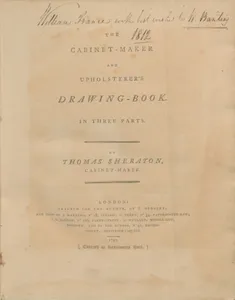
In London, Sheraton's reputation soared through his groundbreaking publications. His masterpiece, *The Cabinet-Maker and Upholsterer's Drawing-Book* (1791–1793, printed by Thomas Bensley), issued in fortnightly parts, featured over 100 meticulously engraved plates showcasing innovative furniture designs, alongside treatises on geometry and perspective. This was followed by *The Cabinet Dictionary* (1803), an encyclopedic guide to techniques like varnishing and gilding, and the incomplete *The Cabinet-Maker, Upholsterer and General Artist's Encyclopaedia* (1805), which previewed Regency motifs. Though he never owned a large workshop, his trade cards and designs, such as one for a piano by Broadwood (1796), underscored his role as a consultant.
Sheraton worked in the Neoclassical tradition, refining late Georgian styles with slender, elegant forms, rectangular backs, and classical motifs inspired by contemporary London workshops and architecture. His draughtsmanship emphasized proportion and feminine grace, bridging Hepplewhite's delicacy and emerging Regency boldness.
Sheraton died impoverished in 1806, buried at St James's Piccadilly, yet his legacy endures as one of the "big three" English designers alongside Chippendale and Hepplewhite. His books disseminated sophisticated tastes across Europe and America, birthing the enduring "Sheraton style"—a generic term for his refined neoclassicism—revived in 19th-century revivals and still emulated today.