Ctrl K
**Vincenzo Feoli, Domenico del Frate, and Agapito Franzetti: Masters of Roman Neoclassical Prints**
Vincenzo Feoli (c. 1760–1827), Domenico del Frate (1765–1821), and Agapito Franzetti were three Italian artists whose careers converged in Rome during the late 18th and early 19th centuries, a period when the Eternal City buzzed with neoclassical fervor and renewed fascination with ancient artifacts unearthed from sites like Herculaneum and Pompeii. Feoli, born around 1760 in Rome, spent his life there, dying in 1827. Del Frate hailed from Lucca, arriving in Rome by the late 18th century where he remained until his death in 1821. Franzetti's activity is documented in Rome from the last quarter of the 18th century into the 1820s, though precise birth and death dates elude records. Their early lives and formal training are not well documented, but their output places them firmly within Rome's vibrant community of engravers and publishers catering to scholars, collectors, and Grand Tourists eager for precise reproductions of classical antiquities.
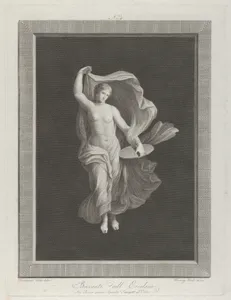
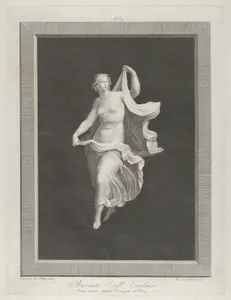
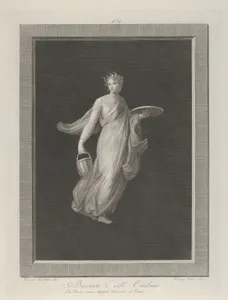
These artists collaborated closely on etchings and engravings that captured the elegance of Greco-Roman sculpture, embodying the neoclassical style's emphasis on line, proportion, and archaeological accuracy. A prime example is *Baccante dell'Ercolano* (Bacchante of Herculaneum), produced in early 19th-century Rome. Here, Feoli served as the engraver, faithfully interpreting del Frate's design of the dynamic, tambourine-playing bacchante against a stark background, with Franzetti as publisher. This print, held in the Victoria and Albert Museum's collections, exemplifies their technical precision in rendering draped forms and expressive poses derived from Herculaneum frescoes. Franzetti also issued views like *Piazza Giudea*, preserved at the Metropolitan Museum of Art, highlighting Rome's own monumental heritage. Working in the etching tradition popular among Roman printmakers, they bridged painting and printmaking to make ancient art accessible.
Though not household names like Canova or Piranesi, Feoli, del Frate, and Franzetti left a legacy in disseminating neoclassical imagery through affordable, high-quality prints. Their works fueled the era's obsession with antiquity, influencing decorators, architects, and amateurs across Europe. Today, surviving impressions in major museums underscore their role in preserving and popularizing Italy's classical revival, offering a window into Rome's artistic workshops at the dawn of the 19th century.
(Word count: 378)