
Ctrl K
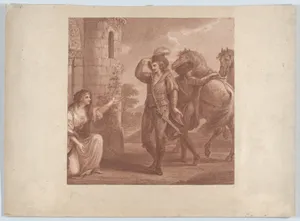
**William Hamilton** (1751–1801) was a British painter and illustrator renowned for his depictions of literary and historical subjects, particularly scenes from Shakespeare’s plays. Born in Chelsea, London, he initially trained as an architectural draftsman before shifting his focus to theatrical portraits and dramatic narrative scenes.)
Hamilton spent several years in Italy working with the painter and architect Antonio Zucchi, which broadened his artistic horizons. Upon returning to England, he entered the Royal Academy Schools in 1769. He became an Associate of the Royal Academy in 1784 and a full Academician in 1789.
His artistic style blended the sentimental elegance of the period—echoing the work of Angelica Kauffman—with occasional dramatic distortions reminiscent of Henry Fuseli. Hamilton excelled in history painting and book illustration, producing works for major publishing ventures such as John Boydell’s Shakespeare Gallery, Thomas Macklin’s Bible, and Robert Bowyer’s *History of England*. Notable paintings include *King Edgar’s First Interview with Queen Elfrida* (1774), numerous Shakespearean scenes such as *Joan and the Furies* and *Isabella appealing to Angelo*, and contemporary historical subjects like *Marie Antoinette Being Taken to Her Execution* (1794). Many of his compositions were engraved by artists including Francesco Bartolozzi, ensuring wide dissemination through popular prints.)
Hamilton’s legacy lies in his contribution to the visual interpretation of literature and history during the late Georgian era. His paintings captured the emotional and dramatic spirit of their subjects, influencing both fine art and the growing market for reproductive prints. He died in London in 1801, leaving a body of work that continues to be appreciated for its narrative clarity and period charm.