
Ctrl K
1700–1800
William Milward (1702–1742) was a British stage actor whose career centered on the London theater scene during the early eighteenth century. He began performing with John Rich’s company at Lincoln’s Inn Fields Theatre and also appeared at the Haymarket before joining the Drury Lane company in 1734, where he remained until his death.
Little is documented about his early life or any formal training. Milward established himself through a steady succession of supporting and character roles in contemporary plays, many by leading dramatists of the period. Among his notable performances were Merit in John Gay’s *The Wife of Bath* (1730), Lusignan in Aaron Hill’s *Zara* (1736), and Conrade in George Lillo’s *Elmerick* (1740). His repertoire reflected the diverse tastes of Georgian audiences, spanning tragedy, comedy, and ballad opera.
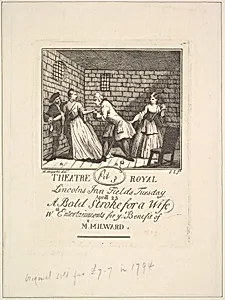
Although primarily known as a performer rather than a visual artist, Milward’s image survives in at least one print: a benefit ticket designed after a design by William Hogarth and etched by Samuel Ireland. This single work in the collection underscores his prominence within London’s theatrical and artistic circles. Milward’s legacy rests on his reliable contributions to the Drury Lane ensemble during a vibrant era of British drama, helping sustain the repertory system that shaped eighteenth-century theater.