Ctrl K
Adam Gutmann, a German artist born in Constance in 1567, spent much of his career active in Salzburg, where he died in 1637. Little is known about his early life or training, which remains sparsely documented, though records place him as a journeyman painter (Malergesellen) in Salzburg by 1597, receiving payments for work including wedding decorations. Described in historical sources as a "Faßmaler" or barrel painter—a craftsman specializing in decorative painting on everyday objects—he also pursued finer artistic endeavors, producing drawings and contributing to sculptural polychromy amid Salzburg's vibrant ecclesiastical art scene under the prince-archbishops.
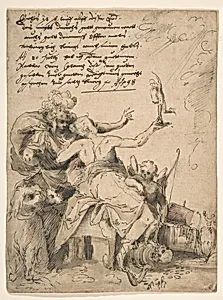
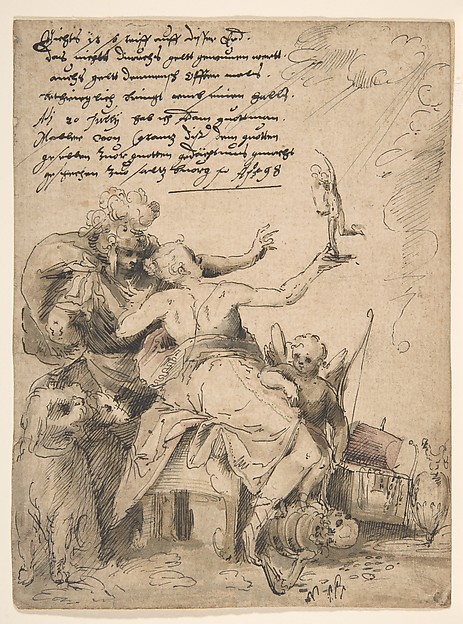
Gutmann's surviving works reveal a talent for intricate allegory and religious iconography. His drawing *An Allegory* (1598), held by the Metropolitan Museum of Art, masterfully blends pen and black ink with gray, brownish-green, and pink washes on a modest 20.3 x 15.2 cm sheet. Originally part of a friendship album, it depicts Venus restraining Mars, Cupid atop a skeleton, and overflowing treasures symbolizing both peace triumphing over war and the vanitas of wealth's fleeting perils—a puzzle-like moral commentary infused with classical deities. Later, around 1619, he created or polychromed wooden sculptures of *St. Rupert* (Inv. no. 503, 232 x 85 x 60 cm) and *St. Virgil* (Inv. no. 504) for Salzburg's Residenzgalerie, possibly in collaboration with sculptor Lorenz Kreuztaler; these figures evoke the emerging Baroque's dramatic presence while rooted in late Renaissance traditions. Archival payments, such as 50 florins in 1600 for unspecified work at Schloss Langenstein near Constance, and a 1615 commission, underscore his steady patronage by local nobility and clergy.
Though not aligned with a prominent school or mentor—suggesting an independent craftsman-artist path—Gutmann's oeuvre reflects Salzburg's transitional style at the turn of the 17th century, bridging Mannerist intricacy and proto-Baroque monumentality in service of religious and allegorical themes. His legacy endures through these rare institutional holdings, offering glimpses into the daily artistry of a peripatetic figure whose humble origins belied sophisticated visual storytelling. Today, Gutmann exemplifies the unsung contributors to Alpine Germany's artistic fabric, preserved amid the grandeur of Salzburg's DomQuartier and New York's Met.
Wikidata (CC0)