
Ctrl K
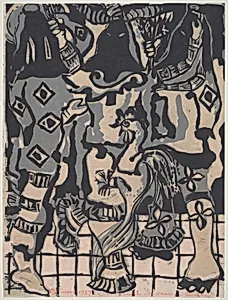
1900–1983
Adja Yunkers (1900–1983), born Adolf Eduard Vilhelm Junker in Riga in what was then the Governorate of Livonia in the Russian Empire, was one of the most internationally peripatetic and stylistically adventurous printmakers and painters of the twentieth century. Restlessly mobile from an early age, Yunkers studied art successively in Leningrad, Berlin, Paris, and London, accumulating a breadth of exposure to European modernism that few of his contemporaries could match. He lived in Paris for approximately fourteen years before relocating to Stockholm in 1939, where he threw himself into cultural journalism, publishing and editing the arts magazines ARS and Creation.
In 1947 Yunkers emigrated to the United States, where he would spend the remainder of his life. He quickly established himself in New York artistic circles, taking up a teaching position at the New School for Social Research and spending summers at the University of New Mexico. He received a Guggenheim Fellowship in 1949, recognition of his rapidly growing reputation as a printmaker of unusual originality. During the 1950s Yunkers worked primarily in color woodcut, a medium he transformed by introducing gestural brushwork into what had traditionally been a more controlled process, aligning the form with the energies of Abstract Expressionism. The resulting prints were large, lyrical, and structurally bold.
In 1960 Yunkers turned to lithography, producing two major series at the Tamarind Lithography Workshop in Los Angeles: Salt (five lithographs) and Skies of Venice (ten lithographs). These works demonstrated his gift for atmospheric color and his ability to sustain formal invention across a sequential body of work. His paintings from the same period reveal a similarly expansive ambition, with large-scale abstract canvases that draw on the gestural freedom of the New York School while maintaining a distinctive personal lyricism. Yunkers's work is held in the permanent collections of major institutions including the Museum of Modern Art, the Guggenheim, and the Whitney Museum, testifying to the enduring force of an artist who remade himself across continents and decades.