Ctrl K
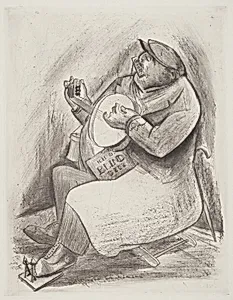
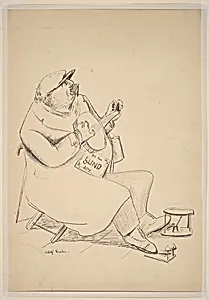
Adolf Dehn was an American artist born in Waterville, Minnesota, in 1895, who became one of the most versatile and witty printmakers and watercolorists of his generation. He studied at the Minneapolis School of Art before moving to New York, where he enrolled at the Art Students League and came under the influence of the League's progressive teaching environment. In the early 1920s he traveled to Europe, spending extended periods in Vienna, Berlin, and Paris, where he absorbed the satirical graphic traditions of the German-language illustrated press and the broader ferment of modernist art.
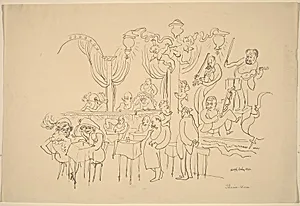
Dehn first gained attention for his lithographs, a medium in which he proved exceptionally gifted. His early prints combined social satire with a fluid, expressive line, targeting the pomposities of Viennese bourgeois society, the excesses of the Weimar-era nightclub world, and, upon his return to America, the contradictions of Depression-era capitalism. He contributed to left-wing publications and was associated with the broader current of social realism that ran through American printmaking in the 1930s. His lithographs of this period are sharp, funny, and technically accomplished, with a caricatural energy that never tips into mere propaganda.
In later years Dehn's work broadened in subject and mellowed somewhat in tone, encompassing landscapes of the American West and Midwest, scenes of jazz clubs and popular entertainments, and the natural world observed with the same alert intelligence he had brought to his social subjects. His watercolors, which he developed as a primary medium alongside lithography, are notable for their luminosity and the ease with which they evoke place and atmosphere. He also wrote instructively about watercolor technique, contributing to the education of other practitioners.
Dehn died in New York in 1968, and his work is held in numerous American museum collections. He is recognized as a significant figure in the American printmaking tradition, one whose career traces an arc from political satire to lyrical landscape while maintaining throughout a consistent quality of observational acuity and graphic intelligence.
All 3 artworks loaded