Ctrl K
1804–1868
Adrien Dauzats (1804-1868) was a French landscape and Orientalist painter who gained recognition for his lithographic skill and faithful transcriptions of architectural monuments across Europe and the Middle East. Born in Bordeaux to a theatrical scenery painter, Dauzats initially trained as a stage designer before completing his artistic education in Paris under landscape painter Michel Julien Gué. His mastery of lithography quickly attracted attention, leading to important commissions illustrating Baron Taylor's ambitious publications documenting France's architectural heritage and exotic locations throughout the Mediterranean world. Dauzats traveled extensively through the Ottoman Empire, accompanying Baron Taylor's 1830 expedition to Egypt and the Near East and later joining the Duc d'Orléans's 1839 military expedition to Algeria. These journeys provided material for Orientalist paintings that he continued producing long after his traveling days ended. A frequent Salon exhibitor known for genre subjects, church interiors, and Eastern landscapes, Dauzats remained active until his death in 1868 while working on illustrations for The Arabian Nights.
Adrien Dauzats was born in Bordeaux on July 16, 1804, into an artistic family. His father worked as a scenery painter at a Bordeaux theatre, and young Adrien naturally gravitated toward theatrical design, initially dreaming of following his father's profession. He received his first training in stage set painting in his native city, learning the techniques of large-scale decorative work and architectural rendering that would inform his later easel paintings.
Seeking greater opportunities, Dauzats moved to Paris to complete his artistic formation. He studied landscape painting under Michel Julien Gué (1789-1843), who provided instruction in compositional principles and techniques specific to depicting natural and architectural subjects. More significantly, Dauzats developed exceptional skill in lithography, the relatively new printmaking technique that was revolutionizing illustrated publishing.
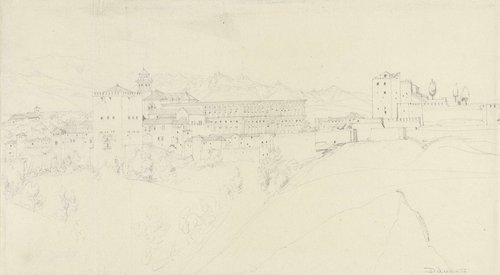
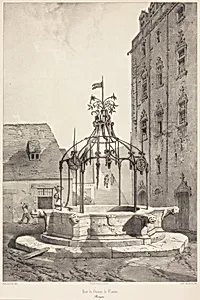
His lithographic mastery quickly brought recognition. The young artist came to the attention of Baron Taylor, the influential writer, cultural administrator, and travel chronicler who was embarking on ambitious illustrated publications documenting France's architectural and scenic treasures. Dauzats's ability to faithfully transcribe monumental architecture and regional landscapes through drawings made from direct observation proved ideal for these projects.
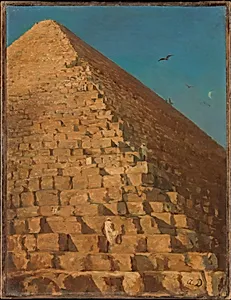
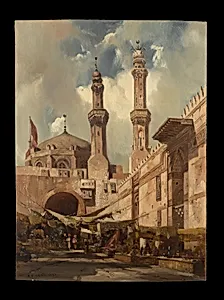
In 1830, Dauzats received a commission that would define much of his subsequent career: he accompanied Baron Taylor's expedition to Egypt and the Near East. The journey took him through landscapes, cities, and monuments that were exotic to European audiences, and Dauzats created numerous drawings documenting archaeological sites, Islamic architecture, and daily life. These works illustrated Baron Taylor's publications including "La Syrie, l'Egypte, la Palestine et la Judée" (1835-39).
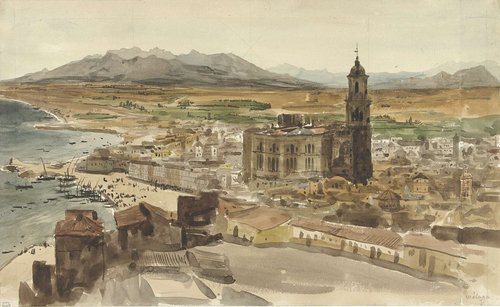
Dauzats's work on these illustrated travel books extended beyond Middle Eastern subjects. He contributed to "Voyages pittoresques et romantiques de l'ancienne France" (1820-63), Baron Taylor's monumental survey of French architectural heritage, and "Voyage pittoresque en Espagne, en Portugal, et sur la côte d'Afrique, de Tanger à Tetouan" (1826-32), demonstrating his versatility across different regional subjects.
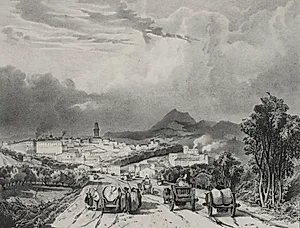
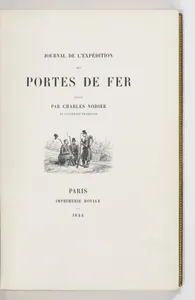
In 1839, Dauzats joined another significant expedition: the Duc d'Orléans's military campaign in Algeria. This provided further Middle Eastern and North African material, consolidating his reputation as an Orientalist painter.
Though the 1839 Algeria expedition proved to be one of Dauzats's last major journeys, he continued painting Orientalist themes for the remainder of his career, drawing on the wealth of material he had gathered during his travels. He became a frequent exhibitor at the Paris Salon, showing genre subjects, interior views of churches, and landscapes that demonstrated his continued engagement with both French and exotic subjects.
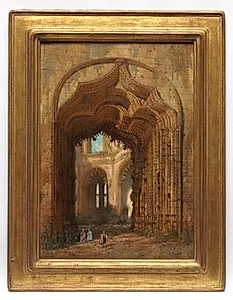
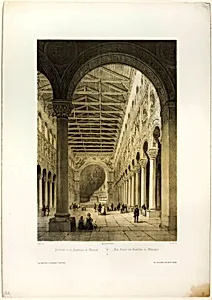
Throughout these later decades, Dauzats maintained his reputation for meticulous architectural rendering combined with atmospheric effects, successfully translating his lithographic precision into oil painting. His church interiors particularly demonstrated his skill at capturing complex spatial relationships and subtle lighting effects.
In 1868, Dauzats accepted a final commission to create four illustrations of characters from the Arabian folktale collection "One Thousand and One Nights" for 2,000 francs each. Madame Aldema, who commissioned the works, paid a 1,000-franc advance when the artist commenced the first work, "Sinbad the Sailor." However, Dauzats died in Paris on February 18, 1868, before completing the painting, ending a career dedicated to bringing distant places and architectural marvels to European audiences.
Artheon Research Team
Last updated: 2025-11-09
Biography length: ~478 words