
Ctrl K
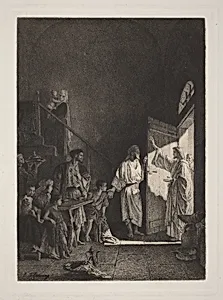
Léopold Flameng (1831–1911) was a distinguished French engraver, illustrator, and painter, born in Brussels to French parents. He began his artistic training in Paris under the engravers Luigi Calamatta and Jean Gigoux, whose guidance honed his exceptional burin and etching techniques. Noticed early by critic Charles Blanc, Flameng quickly established himself as a master reproductive printmaker, interpreting masterpieces by old masters with interpretive finesse rather than mere copying—a tradition he helped sustain into the late nineteenth century before photography's rise.
Flameng's career flourished through collaborations and prolific output. He contributed over 100 illustrations to periodicals like *Gazette des Beaux-Arts* and *L'Artiste* alongside Léon Gaucherel, and etched 26 views for Alfred Cadart's *Paris qui s’en va et Paris qui vient* (1859–1860). Renowned for reproductive etchings, he rendered works after Rembrandt (*The Syndics*, 1876; *40 Œuvres d'après Rembrandt*, 1873), Ingres (*L'Angélique*, 1863; *La Source*, 1882), Delacroix (*L'Exécution de Marino Faliero*, 1863), Jan van Eyck, Leonardo da Vinci, and others, including Alexandre Bida's biblical scenes such as *A Scene from the New Testament*. He also illustrated literary classics, producing etchings for Boccaccio's *Le Décaméron* (1873), Victor Hugo's *L'Année Terrible* (1874), and François Coppée's works, blending technical precision with narrative elegance.
In his later years, Flameng became a revered teacher—mentoring pupils like Paul Adolphe Rajon and his son François Flameng, a noted painter—and collector, earning a medal at the Exposition Universelle (1878), Officer of the Legion of Honor (1894), and election to the Académie des Beaux-Arts (1898). His legacy endures in museum collections worldwide, from the Metropolitan Museum of Art to the National Gallery of Art, celebrating his role as a bridge between etching's golden age and modernism. Flameng's interpretive prints not only preserved masterworks but elevated engraving as an art form in its own right, influencing generations before fading into obsolescence.