
Ctrl K
**Julius Schnorr von Carolsfeld (1794–1872)** was a German painter renowned for his biblical subjects and contributions to the Nazarene movement. Born in Leipzig on 26 March 1794, he was the son of Veit Hanns Schnorr von Carolsfeld, a draughtsman, engraver, and painter who provided his initial artistic training. His earliest works included copies after the Neoclassical drawings of John Flaxman. In 1811 he entered the Vienna Academy, where he studied under Friedrich Heinrich Füger and formed important friendships with Joseph Anton Koch and Heinrich Olivier, both of whom shaped his developing style.
Schnorr joined the Nazarene circle in Rome in 1815, living in the San Isidoro monastery alongside Johann Friedrich Overbeck and other artists who sought to revive the principles of early Renaissance religious art. He initially drew inspiration from fifteenth-century Italian painters such as Fra Angelico before embracing more elaborate High Renaissance models. In Rome he executed notable frescoes illustrating scenes from Ariosto’s works in the Villa Massimo. After marrying Maria Heller in 1827, he returned to Germany, settling first in Munich under the patronage of King Ludwig I, where he directed large-scale fresco cycles depicting the *Nibelungenlied* and scenes from medieval German history in the Residenz palace.
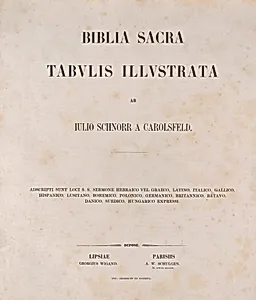
His later career centered on biblical illustration. Appointed professor at the Dresden Academy in 1846 and later director of the Gemäldegalerie, Schnorr produced his celebrated *Picture Bible* (*Biblia Sacra*), published in thirty parts between 1852 and 1860. These intricate designs, often engraved or reproduced by various artists, became widely disseminated and influenced stained-glass commissions, including windows for Glasgow Cathedral and St Paul’s Cathedral in London. His brother Ludwig Ferdinand was also a painter, and his son Ludwig became a noted Wagnerian tenor.
Schnorr died in Dresden on 24 May 1872. The works held under the attribution “Various Artists, after Julius Schnorr von Carolsfeld,” such as the 1853–1860 *Biblia Sacra tabulis illustrata*, directly reflect his enduring legacy as a leading Nazarene draughtsman whose biblical imagery continued to inspire reproductive prints and ecclesiastical art long after his death.