Ctrl K
1837–1911
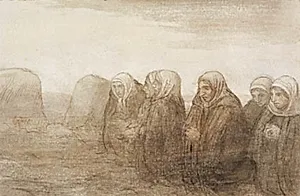
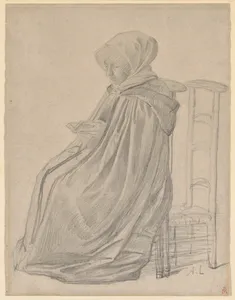
Alphonse Legros (1837–1911) was born in Dijon, France, and trained in Paris at the drawing school of Horace Lecoq de Boisbaudran, whose unconventional teaching method — which emphasised memory drawing and acute observation over academic convention — would leave a lasting mark on Legros's practice. At Lecoq's school he formed friendships with Jules Dalou and Auguste Rodin that endured throughout his life. In the late 1850s he taught himself the art of etching and moved in the radical circles clustered around Gustave Courbet and Édouard Manet, earning the admiring attention of Charles Baudelaire as a painter of peasant religious subjects rendered with unflinching realism.
At the urging of his friend James McNeill Whistler, Legros moved to London in 1863, a city that would become his permanent home. He was naturalised as a British subject in 1881 and spent the rest of his career embedded in British artistic life. After an appointment as teacher of etching at the South Kensington School of Art, he was named Slade Professor of Fine Art at University College London in 1876, a chair he held for sixteen years. Under his direction the Slade became a centre for rigorous draughtsmanship and serious printmaking, training a generation of British artists in the discipline that Legros himself practised with extraordinary range.
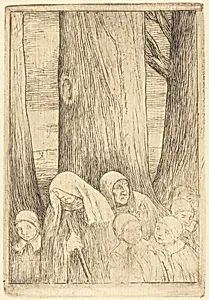
As an etcher Legros was credited, alongside Whistler and Francis Seymour Haden, with reviving the medium in Britain and France at a time when it had fallen out of fashion among serious artists. His prints — austere, tonally complex, often depicting monks, pilgrims, and rural labourers — carried the gravity of his French Realist formation into a delicate graphic language. He was a founding member of the Society of Painter-Etchers in 1881 and played a central role in re-establishing the cast art medal as a serious sculptural form, founding the Society of Medallists in 1885.
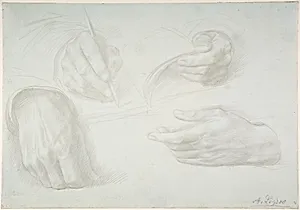
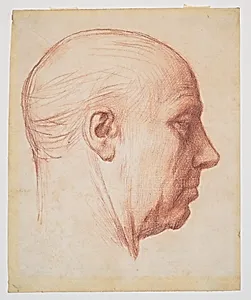
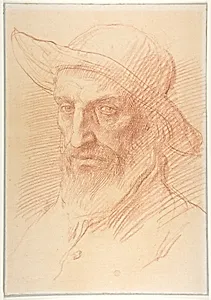
Legros also worked extensively in sculpture and portraiture, producing bronze heads and medals that brought the same directness of observation to three-dimensional work as his graphic art did on the page. Though his reputation faded in the twentieth century as taste shifted away from the Realist tradition he embodied, his influence as a teacher and institution-builder proved enduring: the Slade's emphasis on drawing from life — a legacy he helped establish — has shaped generations of British artists long after his death in 1911.