Ctrl K
1857–1939
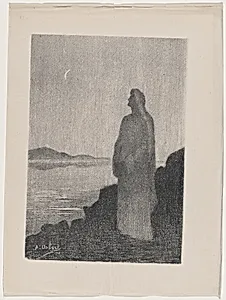
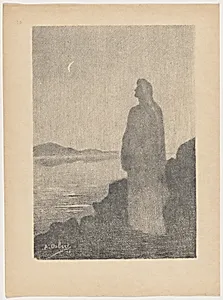
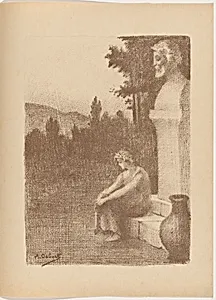
Alphonse Osbert (1857–1939) was a French Symbolist painter whose ethereal visions of ghostlike muses in mysterious nocturnal landscapes made him one of the movement's most distinctive voices. Born in Paris on March 23, 1857, Osbert received rigorous academic training at the École des Beaux-Arts under Henri Lehmann, Fernand Cormon, and Léon Bonnat. His early work reflected his passion for Spanish Old Masters, particularly Jusepe de Ribera, but a profound transformation occurred in the late 1880s under the influence of Post-Impressionism and Symbolism. Osbert abandoned his academic naturalism in favor of a Pointillist technique similar to Seurat and Signac, but applied it to visionary Symbolist subjects rather than contemporary scenes. Between 1892 and 1896, he exhibited at the Salon de la Rose+Croix, the leading platform for Symbolist art. His signature style—ghostlike muses in dreamlike landscapes bathed in the unearthly light of sun or moon, rendered with abundant use of blue—earned these works the designation 'muses nocturnes' (nocturnal muses). Osbert died in Paris on August 11, 1939, just weeks before World War II began.
Alphonse Osbert was born in Paris on March 23, 1857. He trained at the prestigious École des Beaux-Arts, where he worked in the studios of three distinguished academic painters: Henri Lehmann, Fernand Cormon, and Léon Bonnat.
This rigorous academic training grounded Osbert in traditional drawing, composition, and technique. His earliest passion was for the great Spanish masters, particularly Jusepe de Ribera (1591–1652), whose dramatic tenebrism and intense realism influenced Osbert's early work.
During this period, Osbert worked in a conventional academic style, demonstrating technical proficiency but not yet revealing the visionary qualities that would characterize his mature work.
In the late 1880s, Osbert underwent a profound stylistic transformation under the influence of several acquaintances associated with Post-Impressionism and Symbolism. This period marked his decisive break with academic naturalism.
Osbert abandoned conventional painting in favor of a Pointillist technique similar to that employed by Georges Seurat and Paul Signac. However, rather than applying this method to contemporary urban or leisure scenes as the Neo-Impressionists did, Osbert used it for otherworldly, visionary subjects.
This fusion of Post-Impressionist technique with Symbolist content created Osbert's distinctive aesthetic: dreamlike visions rendered with systematic, scientific color application.
Between 1892 and 1896, Osbert exhibited at the Salon de la Rose+Croix, organized by the mystical writer Joséphin Péladan. This salon was the leading exhibition platform for Symbolist artists and provided Osbert with an ideal context for his visionary work.
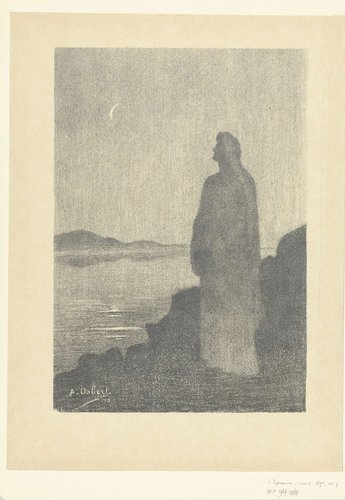
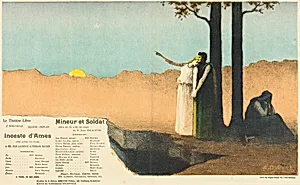
During this period, Osbert fully developed his signature style: ghostlike muses in mysterious landscapes bathed in the unearthly light of a sun or moon, rendered with abundant use of blue. These works became known as 'muses nocturnes' (nocturnal or nighttime muses).
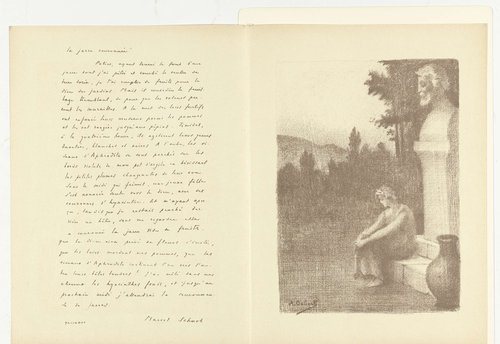
His paintings featured ethereal female figures in classical drapery, set in dreamlike landscapes with reflective waters, classical architecture fragments, and atmospheric effects suggesting twilight or night. The pervasive blue tonality created moods of profound tranquility and spiritual contemplation.
Osbert's mature works often depicted otherworldly landscapes with visionary subjects, maintaining the Pointillist-influenced technique but subordinating it to the creation of mystical, meditative atmospheres.
Alphonse Osbert died in Paris on August 11, 1939, just a few weeks before the start of the Second World War, ending a career that had produced some of Symbolism's most serene and contemplative visions.
Artheon Research Team
Last updated: 2025-11-09
Biography length: ~476 words