Ctrl K
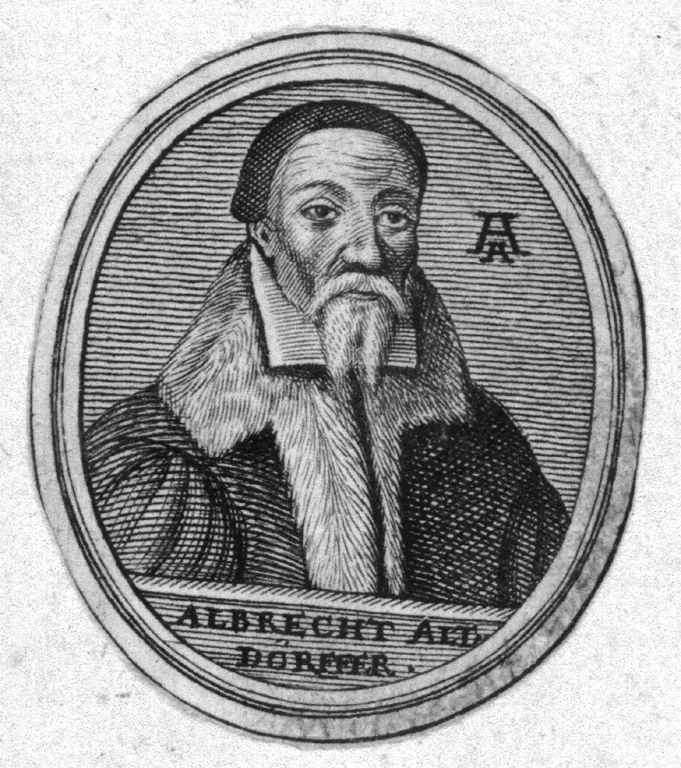
1475–1538
Movements
Occupations
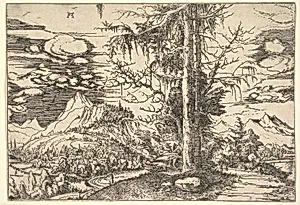
Albrecht Altdorfer (c. 1480–1538) was a German painter, printmaker, and draftsman who stands as one of the founders of landscape painting as an independent genre. Born in Regensburg or nearby Altdorf, he learned art from his father Ulrich, a painter and miniaturist. Altdorfer spent most of his life in Regensburg, becoming a citizen in 1505 and later serving as the city's official architect and a member of its inner council. As the guiding spirit of the Danube School, he was among the first artists to treat landscape not merely as background but as the primary subject—his 'Regensburg Landscape' (c. 1522–25) was one of the first pure landscapes since antiquity. His dramatic 'Battle of Alexander at Issus' (1529), painted for Duke William IV of Bavaria, exemplifies his ability to unite vast panoramic landscapes with historical narrative. Altdorfer's interest in light, atmosphere, and nature's cycles links him spiritually to both Baroque and Romantic landscapists.
Born around 1480 in Regensburg or Altdorf, Germany.
Acquired interest in art from his father Ulrich Altdorfer, a painter and miniaturist.
Developed distinctive approach combining detailed observation of nature with imaginative vision.
Became a citizen of Regensburg in 1505, establishing his permanent base of operations.
Emerged as the guiding spirit of the Danube School alongside Lucas Cranach the Elder and Wolf Huber.
Around 1511 or earlier, traveled down the Danube and south into the Alps, deeply moved by the mountain scenery.
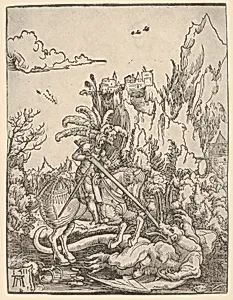
Created works like 'St. George and the Dragon' (1510) where the knight is overwhelmed by primeval forest.
From 1513, worked for Emperor Maximilian I in Innsbruck, receiving commissions from the imperial court.
Produced 'Regensburg Landscape' (c. 1522–25), one of the first pure landscapes without human figures since antiquity.
Developed characteristic style setting biblical and historical subjects against expressively colored landscape backgrounds.
Painted favorite subjects of impenetrable German and Austrian forests with extraordinary atmospheric effects.
In 1529, executed monumental 'Battle of Alexander at Issus' for Duke William IV of Bavaria.
Became member of City Council for External Affairs in 1519, rising to Council for Internal Affairs by 1529.
Returned to Regensburg as a wealthy man, becoming responsible for the city's fortifications.
Served as official architect of Regensburg alongside his artistic activities.
Died February 12, 1538 in Regensburg, leaving a legacy that influenced landscape painting for centuries.
Artheon Research Team
Last updated: 2025-11-28
Biography length: ~820 words
Wikidata/Wikimedia Commons