Ctrl K
1495–1575
**Ambrosius Gemlich (ca. 1500 – after 1542)** was a masterful German etcher, or *Ätzmaler*, renowned for his intricate acid-etchings on blades, firearms, and armor during the Renaissance. Active primarily in Munich and Landshut from around 1520 to 1550, Gemlich transformed utilitarian weapons into exquisite art objects through his pioneering use of etching techniques on steel. His designs featured densely packed motifs such as perpetual calendars with saints' names and feast days, hunting scenes, sieges, and ornamental patterns, often gilded or blackened for dramatic effect. Working in the vibrant South German tradition of arms decoration, he collaborated with leading gunsmiths and armorers, elevating metalwork to a level of sophistication that appealed to imperial patrons.
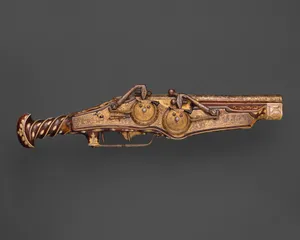
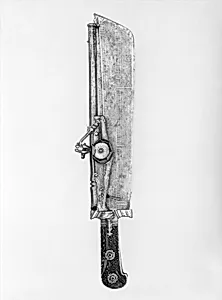
Little is known about Gemlich's early life or formal training, as records from this period are sparse; his origins remain not well documented beyond a possible familial connection to Wilhelm Gemlich, another etcher naturalized in Landshut in 1542. By the 1520s, he had established himself as a sought-after decorator, signing his works with pride. Among his masterpieces is the blade of a *Hunting Knife Combined with Wheellock Pistol* (ca. 1528–29, barrel 1540 or 1546), etched with a Julian calendar for 1529–1534, complete with Latin and Old High German inscriptions—now in the Metropolitan Museum of Art. Another highlight is his decoration on the *Double-Barreled Wheellock Pistol* made for Emperor Charles V by Peter Peck (1540–45), featuring engraved hunting reliefs, gold damascening, and ivory inlays, also at the MET. Gemlich's etchings adorn further treasures, including a Munich hunting knife with a 1528 calendar blade (National Museum in Krakow), a sword with a 1533 calendar (Kunsthistorisches Museum, Vienna), and the half-armor of Conrad von Bemelberg (ca. 1535), etched in collaboration with armorer Wolf Großschedel.
Gemlich's legacy endures as a virtuoso of iron etching, a technically demanding process he perfected to produce vivid, narrative surfaces on otherwise austere metal. His calendars and scenes not only served practical functions—tracking ecclesiastical dates amid turbulent times—but also showcased artistic ingenuity, bridging functionality and fine art. Prized by nobility like Charles V, his contributions influenced subsequent generations of German metal decorators, preserving his name on surviving imperial armories across Europe. Though sparsely documented personally, Gemlich's etched legacy reveals a craftsman whose precision and imagination defined Renaissance arms decoration.(348 words)