Ctrl K
1228–1350
**Amir Khusrau Dihlavi (c. 1253–1325)** was an Indo-Persian poet, musician, scholar, and Sufi mystic of the Delhi Sultanate, celebrated as one of medieval India’s greatest literary figures and often called the “Parrot of India.” Born in Patiyali (in present-day Uttar Pradesh) to a Turkish father who served in the Delhi court and an Indian mother, he lost his father young and was raised in Delhi by his maternal grandfather, who instructed him in Arabic, Persian, and calligraphy. He became a devoted disciple of the Chishti Sufi saint Nizamuddin Auliya, whose influence shaped his spiritual and artistic outlook; he was later buried beside his mentor in Delhi.
Khusrau served as court poet to at least seven Delhi sultans, including Balban, Alauddin Khalji, and Ghiyasuddin Tughlaq, composing in Persian while also pioneering Hindavi (an early form of Urdu/Hindi) verse. His poetic style blended Persian literary traditions with Indian themes, rhythms, and languages, excelling in ghazals, qasidas, and narrative poetry. He is credited with significant contributions to Hindustani music, including the development of qawwali and new musical forms, though few of his compositions survive in notation.
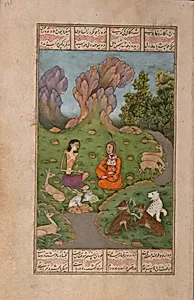
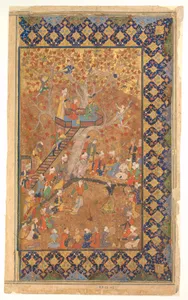
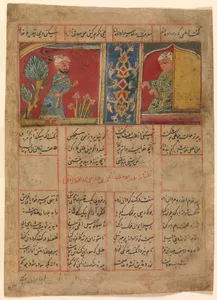
His masterpiece, the *Khamsa* (Quintet), comprises five long narrative poems that became a favorite subject for later manuscript illustration. Folios from 16th- and 17th-century copies—such as those painted by Basawan and Miskin for Mughal patrons—feature vibrant scenes from stories like *Duval Rani Khizr Khan* and moral tales involving pilgrims and princes. These illustrated manuscripts, now held in collections including the Metropolitan Museum of Art and the Freer Gallery, represent some of the finest examples of Indo-Islamic miniature painting.
Khusrau’s legacy endures in South Asian literature, music, and visual arts. His fusion of Persian and Indian elements helped shape Urdu poetry and classical music traditions, while the enduring popularity of his *Khamsa* ensured that generations of painters continued to interpret his narratives in opulent manuscripts. Today he is remembered as a cultural bridge between Central Asian, Persian, and Indian worlds.