Ctrl K
Anatoli Lvovich Kaplan was born on December 26, 1902, in Rogachov, in the Mogilev Governorate of the Russian Empire (present-day Rahachow, Belarus), into a Jewish family living within the Pale of Settlement. Around 1922 he moved to Leningrad, where he would remain for the rest of his life, graduating from the Russian Academy of Arts in 1927. Before turning to printmaking, he spent roughly a decade working as a stage designer—an experience that would sharpen his instinct for dramatic composition and narrative imagery.
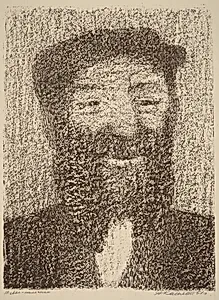
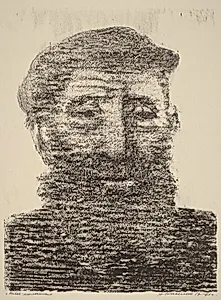
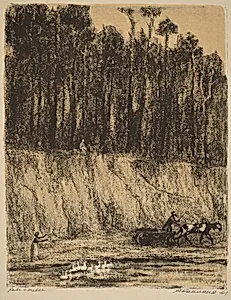
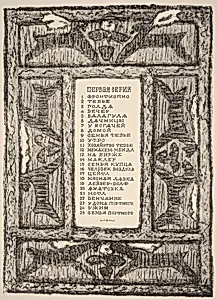
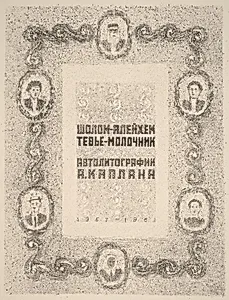
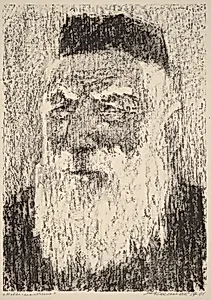
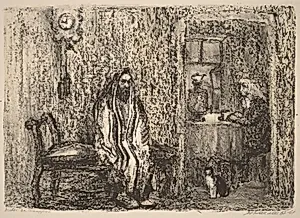
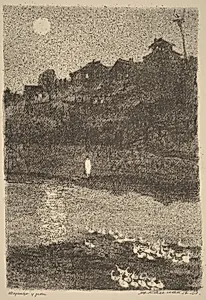
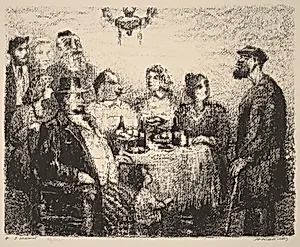
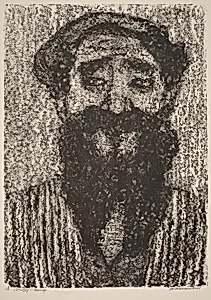
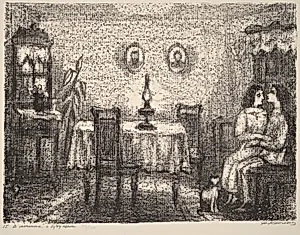
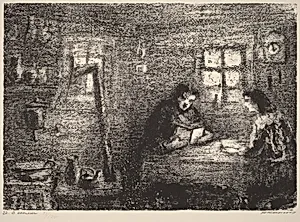
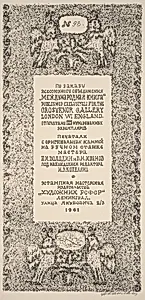
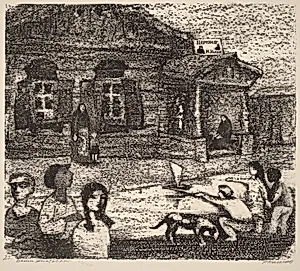
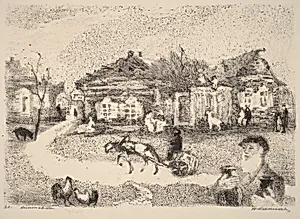
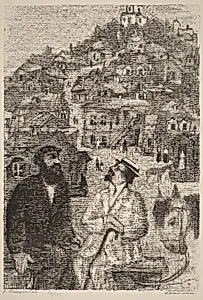
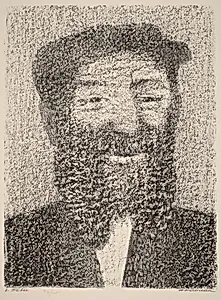
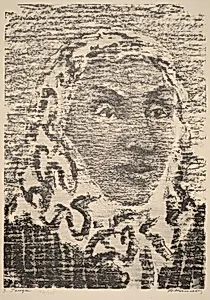
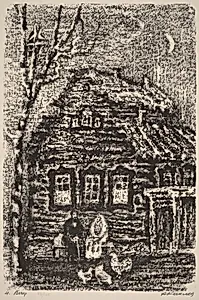
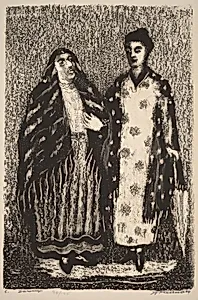
Kaplan began making lithographs in 1937, quickly developing a style that blended lyrical folk-art qualities with deep personal memory. His first major print cycle, Kasrilevka (1937–1940), drew its name and spirit from the fictional Jewish shtetl created by the writer Sholem Aleichem. This embrace of Jewish cultural life would define his career. Later series included three successive treatments of Aleichem's Tevye the Milkman (1957–1966), illustrations for The Enchanted Tailor (1954–1957) and Song of Songs (1962), and a celebrated cycle of colored lithographs based on the Passover folk song Chad Gadya, printed in London in 1961. In 1977 he contributed illustrations to a volume of Dmitri Shostakovich's Jewish Folksongs. Autobiographical paintings such as The Butcher's Shop (1972) and Tailor's Shops (1975) gave visual form to the world of his Belarusian childhood.
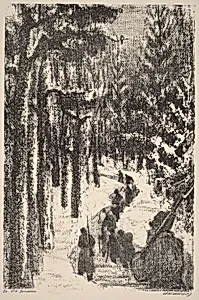
Kaplan's standing as a documentarian of the Leningrad Blockade was established by his lithograph cycle Landscapes of Leningrad during the Days of the Blockade (1948), which was purchased by eighteen Soviet state galleries. Yet from the 1950s onward he concentrated increasingly on Jewish themes despite constant opposition from Soviet cultural authorities, a choice that required both artistic and personal courage. From 1967 he expanded into ceramics and sculpture, including a set of ceramic figures based on the characters of Gogol's Dead Souls.
Kaplan died in 1980, and a major retrospective was held at the Russian Museum in St. Petersburg in 1995, cementing his recognition as one of the most important Jewish artists to have worked under Soviet rule. His prints are held in the collections of the Museum of Modern Art in New York and the National Gallery of Art, among many other international institutions. His life's work stands as a quietly defiant testament to a culture that official policy sought to suppress.