
Ctrl K
1435–1495
**Andrea Guacialoti (also spelled Guazzalotti or Guacialotti)** was an Italian Renaissance medallist and bronze founder active in the mid-to-late fifteenth century. Born in 1435 to Filippo Guacialoti of a Florentine family then domiciled in Prato, he is documented primarily through his surviving works rather than extensive biographical records.
Guacialoti specialized in casting bronze portrait medals, a medium that revived classical Roman coinage traditions during the Renaissance. His pieces typically feature a profile portrait on the obverse paired with symbolic or allegorical scenes on the reverse, often celebrating ecclesiastical or noble patrons. He worked in the Florentine tradition but produced many commissions associated with Rome and papal circles.
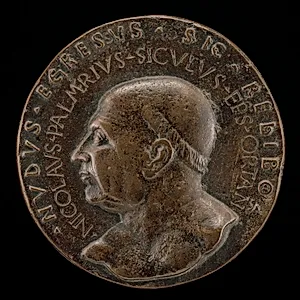
Among his notable works are the medal of Pope Pius II (Aeneas Silvius Piccolomini), dated 1458–1464, with a reverse showing a pelican in her piety; the 1467 medal of Niccolò Palmieri, Bishop of Orte, featuring a male figure holding an hourglass; and the 1481 medal of Alfonso II of Aragon, Duke of Calabria (later King of Naples), depicting his triumphal entry into Naples on the reverse. He also created medals for Pope Sixtus IV around the same period.
The National Gallery of Art holds twelve examples of his medals, underscoring his importance in Renaissance numismatic art. Guacialoti’s precise modeling and attention to symbolic detail helped elevate the portrait medal as a sophisticated vehicle for political and religious propaganda. His output, concentrated between the 1450s and 1480s, influenced later generations of Italian medallists and remains prized by collectors and museums for its historical and artistic value.
![Alfonso II of Aragon, 1448-1495, Duke of Calabria 1458, afterwards King of Naples 1494 [obverse]](https://images.artheonmuseum.org/nga/thumb/alfonso-ii-of-aragon-1448-1495-duke-of-calabria-nga-45601.webp)
![Alfonso's Triumphal Entry into Naples [reverse]](https://images.artheonmuseum.org/nga/thumb/alfonsos-triumphal-entry-into-naples-reverse-nga-45602.webp)
![Sixtus IV (Francesco della Rovere, 1414-1484), Pope 1471 [obverse]](https://images.artheonmuseum.org/nga/thumb/sixtus-iv-francesco-della-rovere-1414-1484-pope-nga-44698.webp)
![Constancy with Turkish Captives [reverse]](https://images.artheonmuseum.org/nga/thumb/constancy-with-turkish-captives-reverse-nga-44699.webp)
![Alfonso II of Aragon, 1448-1495, Duke of Calabria 1458, afterwards King of Naples 1494-1495 [obverse]](https://images.artheonmuseum.org/nga/thumb/alfonso-ii-of-aragon-1448-1495-duke-of-calabria-nga-70396.webp)
![Alfonso's Triumphal Entry into Naples [reverse]](https://images.artheonmuseum.org/nga/thumb/alfonsos-triumphal-entry-into-naples-reverse-nga-70397.webp)
![Male Figure Holding an Hourglass [reverse]](https://images.artheonmuseum.org/nga/thumb/male-figure-holding-an-hourglass-reverse-nga-44695.webp)
![Pius II (Aeneas Silvius Piccolomini, 1405-1464), Pope 1458 [obverse]](https://images.artheonmuseum.org/nga/thumb/pius-ii-aeneas-silvius-piccolomini-1405-1464-pope-nga-45534.webp)
![Pelican in Her Piety [reverse]](https://images.artheonmuseum.org/nga/thumb/pelican-in-her-piety-reverse-nga-45535.webp)
![Borgia Arms with Tiara [reverse]](https://images.artheonmuseum.org/nga/thumb/borgia-arms-with-tiara-reverse-nga-44697.webp)
![Callistus III (Alfonso de Borja, 1378-1458), Pope 1455 [obverse]](https://images.artheonmuseum.org/nga/thumb/callistus-iii-alfonso-de-borja-1378-1458-pope-nga-44696.webp)