
Ctrl K
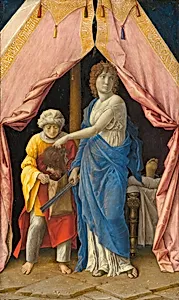
Andrea Mantegna (c. 1431–1506), born in Isola di Carturo near Padua, entered the workshop of Francesco Squarcione at age eleven, where he trained rigorously in painting and the study of classical Roman antiquities from Squarcione's collection of ancient fragments. This Paduan apprenticeship instilled in him a sculptural approach to figures, further honed by the influence of Florentine sculptor Donatello. In 1453, Mantegna married Nicolosia, daughter of Venetian master Jacopo Bellini, forging ties to the Bellini family and blending Paduan precision with Venetian colorism. He worked in the Italian Renaissance tradition, emphasizing spatial illusionism, foreshortening, and antique motifs.
Court painter to the Gonzaga family in Mantua from 1460, Mantegna produced masterpieces like the *Camera degli Sposi* frescoes (completed c. 1474), the monumental *Triumphs of Caesar* cartoons (c. 1486–1492), and the poignant *Lamentation over the Dead Christ* (c. 1490). His small-scale *Judith with the Head of Holofernes* (c. 1495/1500), a tempera on poplar panel depicting the biblical heroine in serene contrapposto with sculptural drapery, exemplifies his late style of moralizing classicism—possibly executed by a follower such as Giulio Campagnola (c. 1482–c. 1515), whose father Girolamo was a disciple of Squarcione and who trained amid Mantegna's Mantuan circle before pioneering stipple engraving in Venice.) Campagnola's exposure to Mantegna's workshop is evident in his early engravings after the master's designs, like *The Triumph of Caesar: The Elephants* (c. 1497).
Mantegna's legacy endures in his revolutionary ceiling illusions, inspiring Correggio and centuries of quadratura frescoes, while his prints disseminated his style across Europe, influencing Albrecht Dürer and Leonardo da Vinci. Campagnola extended this through engraving innovations, adopting Domenico Campagnola as his son and protégé. Their shared Paduan-Venetian lineage underscores the collaborative vitality of Renaissance workshops, where masters like Mantegna shaped generations.