Ctrl K
1826–1888
Andrew John Henry Way was born on April 27, 1826, in Washington, D.C., and became one of the leading still-life painters of the American mid-Atlantic in the late nineteenth century. His early artistic training began around 1847 in Cincinnati under the portrait painter John Peter Frankenstein, followed by further study in Baltimore with Alfred Jacob Miller. In 1850 he traveled to Europe, working in the Paris atelier of Michel Martin Drolling and at the Academy of Fine Arts in Florence until 1854. Upon his return he settled permanently in Baltimore, where he first established himself as a portrait and miniature painter.
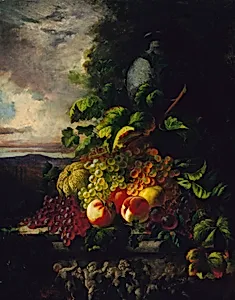
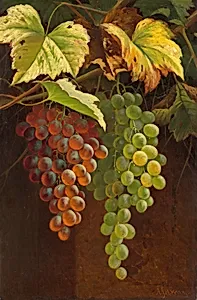
Around 1859–1860, after receiving encouragement from the history painter Emanuel Leutze, Way turned decisively to still life, adopting a Düsseldorf-influenced approach of precise observation and rich lighting. He specialized in luminous, trompe-l’oeil depictions of grapes—often hanging clusters of named varieties such as Prince Albert, Black Hamburg, or Flammé de Tokay—set against dark or neutral grounds, as well as oysters and other fruits arranged on tabletops or marble ledges. Early compositions recalled the Dutch-inspired still lifes of the Peale family, while later works grew more atmospheric, evoking the sober opulence of Willem Kalf. A notable example is The Wealth of Autumn (1869), an elaborate arrangement of peaches, grapes, and foliage framed by cupids and an idyllic landscape.
Way’s most important patron was the Baltimore collector William T. Walters, who placed his greenhouse at the artist’s disposal and acquired works such as Bunch of Grapes (1873), painted from Prince Albert grapes grown at Walters’s estate. Way exhibited frequently at the National Academy of Design and earned a medal for excellence at the 1876 Centennial Exposition in Philadelphia. His paintings entered major collections including the Walters Art Museum and the Smithsonian American Art Museum.
A respected leader in Baltimore’s cultural life, Way helped found the Maryland Academy of Fine Arts in 1871 and the Charcoal Club in 1885. He died in Baltimore on February 7, 1888, leaving a legacy as the region’s foremost still-life specialist whose meticulously observed fruits continue to convey the abundance and tactile beauty of the natural world.
All 2 artworks loaded