Ctrl K
1902–1984
Ansel Adams, born on February 20, 1902, in San Francisco, California, grew up as the only child of Charles Hitchcock Adams, a businessman and astronomy enthusiast who tutored him at home, and Olive Bray, with whom he had a distant relationship. A hyperactive child prone to illness, Adams struggled in formal schooling and was educated by private tutors and his father until graduating from eighth grade. At age 14, a family trip to Yosemite National Park in 1916 profoundly shaped him; gifted a Kodak Box Brownie camera, he began photographing landscapes there, marking his shift from aspiring classical pianist—self-taught initially, then under lessons—to photography. He joined the Sierra Club in 1920, serving as caretaker at LeConte Memorial Lodge and guiding High Trips, honing his skills amid the Sierra Nevada without formal art training.
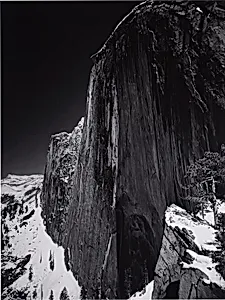
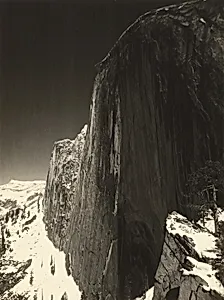
In 1928, Adams married Virginia Rose Best, daughter of Yosemite painter Harry Best, whose studio they later transformed into the family-owned Ansel Adams Gallery; the couple had two children, Michael and Anne. His style evolved from early Pictorialism to straight photography after meeting Paul Strand in 1930, emphasizing sharp focus and full tonal range. A founder of Group f/64 in 1932 alongside Edward Weston and Imogen Cunningham, Adams championed "pure" photography using large-format view cameras. He co-developed the Zone System with Fred Archer in 1940, a precise method for exposure and printing to realize "previsualized" images. Iconic works include *Monolith, the Face of Half Dome* (1927), his first fully visualized photograph; *Moonrise, Hernandez, New Mexico* (1941); *The Tetons and the Snake River* (1942); and *Clearing Winter Storm, Yosemite* (c. 1944), capturing the sublime drama of the American West.
Adams's legacy endures as the preeminent 20th-century landscape photographer and conservationist, serving on the Sierra Club board for 37 years and using his images to advocate for Kings Canyon National Park's creation in 1940. His photographs for the U.S. Department of the Interior and books like *Sierra Nevada: The John Muir Trail* (1938) elevated wilderness preservation, earning him the Presidential Medal of Freedom in 1980. By establishing photography departments at institutions like the Museum of Modern Art and authoring technical manuals, Adams affirmed photography as fine art, his Yosemite oeuvre symbolizing America's vanishing wild beauty.