Ctrl K
1575–1650
**Antoon Sallaert (also known as Anthonis or Antoine Sallaert)** was a Flemish Baroque painter, draughtsman, printmaker, and tapestry designer active primarily in Brussels. Born in 1594 and baptized there, he died in July 1650 and was buried in the Chapel Church.
He trained as a pupil of the Brussels painter Michel de Bordeaux (Michiel Bordeaux) beginning in 1606 and registered as a master in the Brussels Guild of Saint Luke in 1613. While some sources have suggested a connection to Peter Paul Rubens, there is no firm evidence he studied or worked directly in Rubens’s workshop, though his style shows clear affinities with the Rubensian manner.
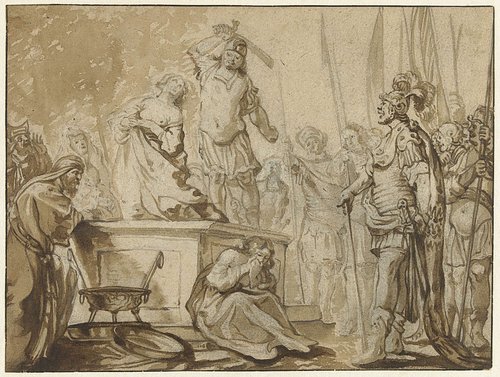
Sallaert worked in the Flemish Baroque tradition, producing religious and mythological paintings, portraits, and designs for local churches, the Brussels court of the Archdukes Albert and Isabella, and Jesuit institutions. His painting style features nervous brushstrokes, lively outlines, expressive distortions, and dramatic foreshortening; early works emphasize monumentality and light effects, while later ones grow more calligraphic and mannered. He was especially renowned as an innovative printmaker—credited with early experiments in the monotype technique in the 1640s—and as a prolific designer of tapestries. Notable tapestry series include *The Sufferings of Cupid* and *The Life of Man*, the latter inspired by Otto van Veen’s emblem book. He also created woodcuts, etchings, and book illustrations, often engraved by others such as Christoffel Jegher.
Sallaert married Anna Verbruggen; their son Jan Baptist Sallaert trained with his father and became a painter himself. He served twice as deacon of the Guild of Saint Luke (1633 and 1648) and received tax relief in 1646 for his contributions to the Brussels tapestry industry. His legacy rests on his versatility across media, his role in sustaining and innovating local tapestry production, and his inventive printmaking, which helped bridge traditional Flemish practices with more experimental approaches during the Rubens era.