Ctrl K
1845–1916
**Marius Jean Antonin Mercié** (1845–1916) was a prominent French sculptor, medallist, and painter whose career exemplified the academic traditions of the Third Republic. Born in Toulouse on October 30, 1845, he moved to Paris to study at the École des Beaux-Arts under the esteemed sculptors François Jouffroy and Alexandre Falguière. In 1868, at just 23, he won the prestigious Grand Prix de Rome with his composition *Thésée vainqueur du Minotaure*, which allowed him to spend several years refining his skills at the Villa Medici in Rome.
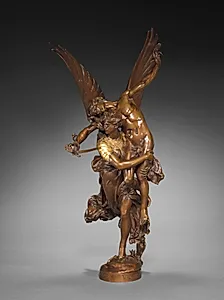
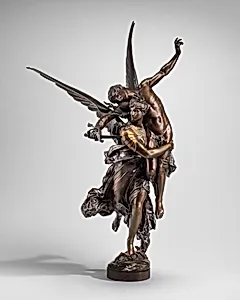
Mercié’s artistic style blended classical ideals with dramatic realism and patriotic fervor, characteristic of late-19th-century academic sculpture. He gained early acclaim with *David vainqueur du Goliath* (modeled around 1870–72), a dynamic bronze depicting the biblical hero sheathing his sword beside Goliath’s head; it earned a first-class medal at the 1872 Paris Salon. His breakthrough came in 1874 with *Gloria Victis* (“Glory to the Vanquished”), a powerful bronze group of a winged figure of Fame lifting a fallen soldier. Created in response to France’s defeat in the Franco-Prussian War, it won the Salon’s Medal of Honour and became one of the era’s most reproduced patriotic monuments. From the 1880s onward he also painted, producing works such as *Venus* and *Michelangelo Studying Anatomy*.
Throughout his later career, Mercié received numerous honors, including election to the Académie française in 1891 and appointment as professor of drawing and sculpture at the École des Beaux-Arts, where he mentored artists including Constantin Brâncuși. He served as president of the Société des artistes français from 1913 and created numerous public monuments, portrait busts, and funerary sculptures, as well as notable works in the United States such as the equestrian statue of Robert E. Lee in Richmond and the Francis Scott Key Monument in Baltimore. Mercié died in Paris on December 12, 1916. His legacy endures through his influential teaching, his role in the “École toulousaine” group of sculptors, and the many civic monuments that continue to embody French national memory and academic excellence.