
Ctrl K
Antonio Baratti (also spelled Baratta), born on 7 January 1724 in Belluno, Italy, became one of the most industrious reproductive engravers of the eighteenth century. He trained in the prominent Venetian workshop of Joseph Wagner, sharing the studio with fellow pupils Fabio Berardi and Francesco Bartolozzi, before gaining further experience in Bassano del Grappa. After marrying the skilled letter-engraver Valentina Monaco, he opened his own thriving workshop, where he was supported by his wife, their three sons Domenico, Tommaso, and Pietro, and pupils such as Antonio Sandi and Giuseppe Daniotto.
Working in the Venetian school of reproductive printmaking, Baratti distinguished himself as a consummate technician rather than an original inventor of designs. He specialized in preparing copper plates first with etching (acquaforte) and then finishing them with the burin, a method that enabled the rapid yet precise production of illustrations demanded by publishers. His prints emphasize clarity and fidelity to the source, whether copying paintings by Paolo Veronese, Guido Reni, or Giovanni Battista Piazzetta, or rendering technical diagrams. Though they lack the luminous elegance associated with Bartolozzi, Baratti’s plates were prized for their reliability and ingenuity.)
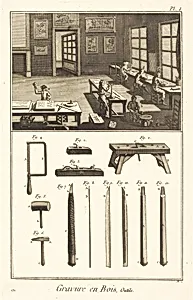
His prodigious output included more than 140 independent religious and portrait prints as well as thousands of book illustrations. He supplied 121 plates for the Italian edition of André Declaustre’s Dizionario mitologico (1755–1758) and an astonishing 997 plates for the 33-volume Livorno edition of Diderot’s Encyclopédie (1770–1779). Among the latter are the celebrated series on engraving techniques, including Gravure en Bois, Outils: pl. I (1771–1779), executed after the original designs of A.-J. de Fehrt and J.-R. Lucotte. Other highlights include illustrations for Carlo Goldoni’s collected works and a dramatic 1782 etching of a nocturnal spectacle honoring the Grand Dukes of Russia at Venice’s Teatro San Benedetto.
Baratti died in Venice on 28 July 1787, having left an indelible mark on Italian print culture through his collaboration with the era’s leading publishers. His family workshop carried on some of his technical traditions, and his Encyclopédie plates continue to serve as invaluable visual records of Enlightenment crafts and processes. Today they are held in major collections, testifying to the quiet but essential role he played in disseminating knowledge and art across eighteenth-century Europe.