Ctrl K
1631–1722
Antonio Zanchi (1631-1722) was an Italian Baroque painter who became one of Venice's most prominent artists during the late seventeenth century, known particularly for his dramatic large-scale religious canvases characterized by dynamic compositions, rich color, and intense emotional expression. Born in Este in the Veneto region, Zanchi established himself in Venice where he absorbed the city's great coloristic tradition while also embracing the tenebrism (dramatic use of light and shadow) that had revolutionized Italian painting through Caravaggio and his followers. Zanchi's artistic significance rests on his ability to synthesize Venetian colorism with dramatic tenebrism and the dynamic compositional energy of the High Baroque. His prolific output spread across the Veneto and beyond to Bavaria, creating a body of work that influenced the development of late Baroque painting in northern Italy and southern Germany. His first masterpiece, The Plague of Venice painted for the Scuola di San Rocco in 1666, established his reputation and demonstrated his ability to handle complex multi-figure compositions with both technical virtuosity and emotional power.
Antonio Zanchi was born on December 6, 1631, in Este, a town in the Veneto region of northeastern Italy. Este, though not a major artistic center, was part of the broader Venetian cultural sphere, and ambitious young artists from the region typically gravitated to Venice for training and career opportunities.
Zanchi moved to Venice to pursue artistic training, studying with a succession of masters who introduced him to different facets of Venetian painting tradition. He trained under Giacomo Pedrali, Matteo Ponzone, and Francesco Ruschi, each contributing to his artistic formation.
Through these teachers, Zanchi learned the technical foundations of Venetian painting: the emphasis on color over line (in contrast to Florentine-Roman disegno), the use of canvas rather than panel, and the rich, oil-based painting techniques that had characterized Venetian art since Titian.
During his formative years, Zanchi was profoundly influenced by two contemporary masters: Luca Giordano, the Neapolitan painter known for his virtuosic technique and dramatic compositions, and Giovan Battista Langetti, a Genoese painter working in Venice who specialized in powerful tenebrist works. These influences shaped Zanchi's emerging style.
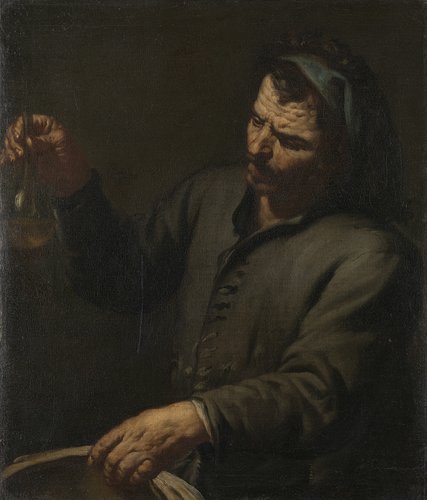
Zanchi became known in the 1660s as a prominent tenebrist, creating paintings characterized by dramatic contrasts between light and shadow, deep shadows punctuated by sharp illumination, and an overall mood of intensity and emotional power. This style descended from Caravaggio's revolutionary use of chiaroscuro earlier in the century.
His first masterpiece came in 1666 with the commission to paint The Plague of Venice for the Scuola di San Rocco, one of Venice's important confraternities. The Scuola di San Rocco was particularly associated with plague imagery, as San Rocco (Saint Roch) was invoked as a protector against plague.
The Plague of Venice demonstrated Zanchi's ability to handle large-scale compositions with multiple figures, complex spatial arrangements, and emotionally charged subject matter. The painting captured the horror and pathos of epidemic disease while maintaining compositional coherence and visual power.
This commission established Zanchi's reputation as a painter capable of executing the large religious canvases that filled Venetian churches and scuole (confraternity halls). It led to numerous subsequent commissions for similar works throughout the Veneto region.
In the 1670s, Zanchi traveled to Germany, where he executed important commissions for Bavarian patrons. This northern sojourn brought Venetian Baroque painting to German audiences and secured Zanchi income and prestige beyond the Italian market.
During his German period, Zanchi created works for the Munich Residenz, the palace of the Bavarian rulers, and the Theatine Church (Theatinerkirche) in Munich, one of the city's most important Baroque churches. These commissions placed Zanchi's work in prominent locations where it influenced the development of Bavarian Baroque painting.
The experience of working in Germany may have influenced Zanchi's style, as he encountered different artistic traditions and patron expectations. German Baroque art often emphasized dramatic narrative and emotional intensity, qualities already present in Zanchi's work but perhaps intensified through this northern exposure.
Zanchi's success in Germany demonstrated the international market for Italian Baroque painting and the continued prestige of Venetian artistic training throughout Europe. It also provided him with financial security that supported his subsequent career.
Returning to Venice, Zanchi established himself as one of the city's most successful and prolific painters. His works could be found not only in Venice but throughout the Veneto region and beyond: in Padua, Treviso, Rovigo, Verona, Vicenza, Loreto, Brescia, Milan, and Bergamo.
Zanchi's mature style combined his established tenebrism with the rich color palette characteristic of Venetian tradition. His works from this period are characterized by dynamic compositions featuring diagonal movement and complex spatial arrangements, a rich color palette emphasizing deep reds, golds, and blues, and intense emotionalism conveyed through dramatic gestures and facial expressions.
He trained important pupils including Antonio Molinari and Francesco Trevisani, both of whom became significant painters in their own right. Molinari continued working in Venice, while Trevisani achieved success in Rome, spreading Zanchi's influence across different Italian artistic centers.
Antonio Zanchi died in Venice on April 12, 1722, at the age of ninety, having witnessed nearly the entire development of Baroque painting in Venice and having contributed substantially to the tradition through his prolific output, his influence on younger artists, and his synthesis of Venetian colorism with dramatic Baroque energy.
Artheon Research Team
Last updated: 2025-11-09
Biography length: ~492 words
All 2 artworks loaded