
Ctrl K
1891–1991
Aries Fayer was a Hungarian-American printmaker born in 1891. Little is documented about his early life or formal training, though he established himself as an artist working primarily in woodcut and etching techniques after immigrating to the United States. His practice centered on capturing the energy and architecture of American cities through stark contrasts, sharp angles, and high vantage points that emphasize urban density and movement.
Fayer gained recognition for his precise and atmospheric prints during the 1920s and 1930s. He was active in Los Angeles in the late 1920s and early 1930s, where he produced works reflecting both East Coast and West Coast scenes. His style aligned with early twentieth-century American printmaking traditions that favored graphic clarity and social observation, often rendering bridges, streets, and cityscapes with dramatic lighting and simplified forms.
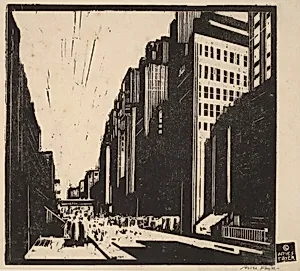
Among his notable works is the 1927 woodcut *New York, 48th Street*, which depicts a narrow urban corridor from an elevated perspective and is held in the collection of the National Gallery of Art. Other prints include *East River Bridges* (circa 1940) and a woodblock portrait of Abraham Lincoln. His pieces also appear in the Brooklyn Museum, underscoring his contribution to American graphic arts of the period.
Fayer’s legacy endures through these institutional holdings and the continued interest in his evocative depictions of modern American life. Though his output was relatively focused, his prints offer valuable insight into the visual language of urban America between the wars, preserving a distinctive voice in the history of printmaking.