Ctrl K
1819–1896
**Armand-Hippolyte-Louis Fizeau (1819–1896)** was a French physicist whose pioneering work in photography placed him among the earliest practitioners of the medium as both a scientific tool and an artistic pursuit. Born in Paris to Louis and Beatrice Fizeau, he married into the prominent de Jussieu botanical family. His earliest experiments focused on refining photographic processes, particularly the daguerreotype, at a time when the new technology was rapidly evolving from novelty to practical art form.
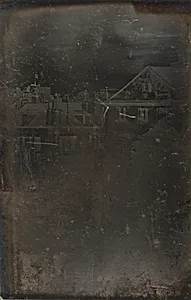
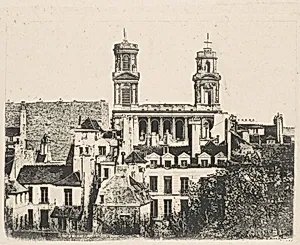
Fizeau developed an innovative method for etching directly into the copper daguerreotype plate, transforming the unique image into a reusable printing plate capable of producing multiple ink impressions on paper. This photogravure technique, though imperfect and often resulting in prints with a more primitive appearance than the original daguerreotype’s tonal richness, allowed for wider dissemination of photographic images. Working in the experimental tradition of early photography, he frequently captured urban views from his Paris rooftop, favoring subjects like the Church of Saint-Sulpice. A notable example is his ca. 1841 photogravure *St. Sulpice, Paris*, which demonstrates remarkable detail in architectural textures and rooftops.
He collaborated with Léon Foucault on investigations into the interference of light, bridging his photographic and optical research. While best remembered today for his 1849 measurement of the speed of light and the 1851 Fizeau experiment on light in moving water, his photographic innovations helped transition the medium from studio-bound portraits to documentary views of the world. Fizeau’s contributions earned him membership in the Académie des Sciences and lasting recognition; his name is one of the 72 inscribed on the Eiffel Tower. His work exemplifies the fertile intersection of science and art in the nineteenth century, preserving early glimpses of Paris through a medium he helped advance.
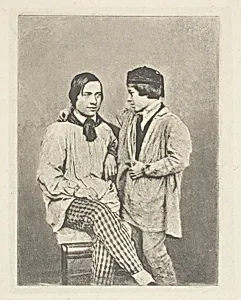
![[Man and Boy]](https://images.artheonmuseum.org/met/ph/thumb/man-and-boy-269070.webp)
![[Paris Rooftops]](https://images.artheonmuseum.org/met/ph/thumb/paris-rooftops-286254.webp)