Ctrl K
Armin Landeck (1905–1984) was a master American printmaker whose architectural precision and mastery of light and shadow captured the geometry of urban and rural America. Born on June 4, 1905, in Crandon, Wisconsin, he displayed an early fascination with art and architecture. Landeck studied at the University of Michigan before transferring to Columbia University, where he earned a bachelor's degree in architecture in 1927. That same year, he took life drawing classes with George B. Bridgman at the Art Students League and produced his first prints at Columbia. Newly married to Mabel, he embarked on an eighteen-month journey through Europe—from Paris and Berlin to Vienna, Italy, and Turkey—sketching and etching historic architecture, an experience that profoundly shaped his eye for structure and form.
Returning amid the Great Depression, Landeck pivoted from architecture to full-time printmaking, unable to find work in his field. He studied etching and engraving with Stanley William Hayter at Atelier 17 in the early 1940s, at the New School for Social Research, honing techniques like drypoint, aquatint, lithography, and copper engraving. In 1934, he co-founded the short-lived School for Printmakers with Martin Lewis at George Miller's lithography studio, teaching etching, drypoint, and more. Landeck taught at the Brearley School from 1931 to 1958 and later as a professor at the Art Students League, while producing over 160 prints that blended realism with modernist geometry—sharp lines, rhythmic shadows, and symphonic tonal depth evoking Precisionist influences like Charles Sheeler and Edward Hopper.
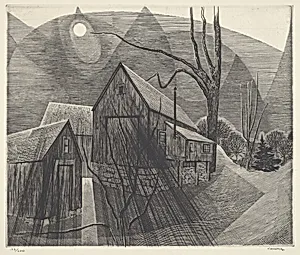
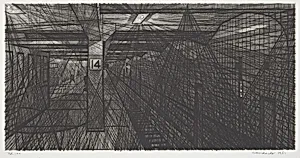
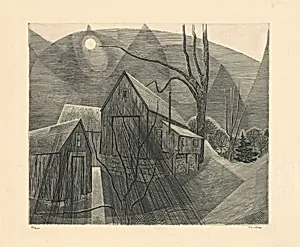
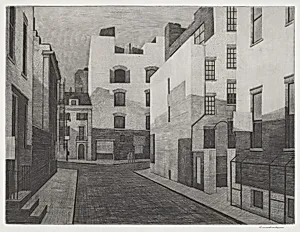
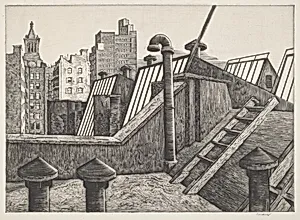
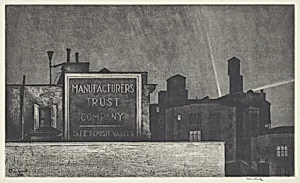
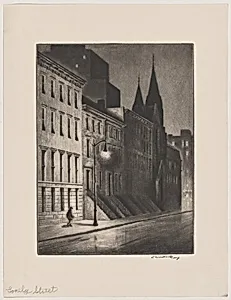
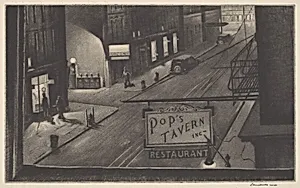
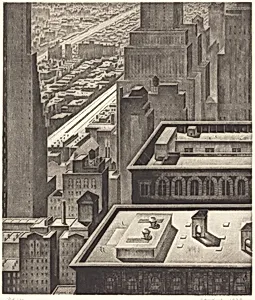
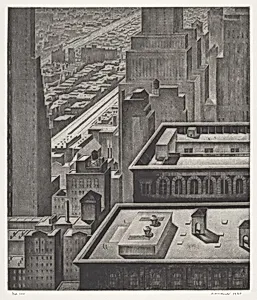
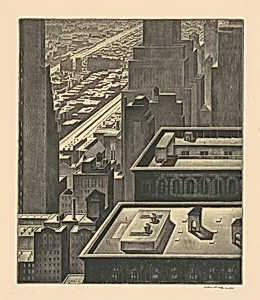
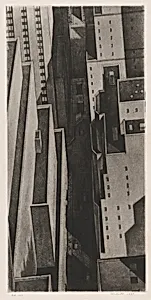
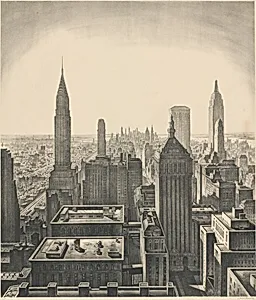
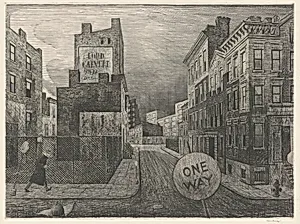
Landeck's oeuvre features iconic New York City scenes and Connecticut countrysides, such as *Village Nocturne* (1933), *Manhattan Canyon* (1934), *Lonely Street* (1936), *Rooftop with Ventilators* (1942), *Stairhall* (1950), *Shadowed Street* (1947), *Manhattan Moonlight* (1947), and *Rooftop and Skylights* (1969). Other standouts include *Narrow Street* (Art Institute of Chicago) and *Alleyway* (Metropolitan Museum of Art). His works emphasize kinetic energy through fragmented forms, radiant lines, and dramatic light play, transforming everyday structures into poetic compositions.
Awarded a Guggenheim Fellowship in 1953, Landeck was elected to the National Academy of Design and the American Academy of Arts and Letters, and exhibited with the Society of American Graphic Artists. Retiring to his Litchfield, Connecticut farm, his prints grace major collections including the Whitney Museum, MoMA, National Gallery of Art, and Smithsonian. Landeck died on December 1, 1984, leaving a legacy of technical virtuosity that continues to illuminate American printmaking's golden age.
All 16 artworks loaded