Ctrl K
1831–1900
Arthur Frederick Payne (1831–1910) was a British artist and amateur cricketer born on 7 December 1831 in Leicester.) His early life revolved around academics and sport; he matriculated at Trinity College, Oxford, in 1851, earning a B.A. in 1856, while playing first-class cricket for Oxford University Cricket Club and the Marylebone Cricket Club (MCC) from 1854 to 1867 as a right-handed batsman.) Though his artistic training remains undocumented, Payne began producing detailed watercolors in the early 1850s, capturing precise topographical views often inscribed with exact dates and locations, suggesting a self-taught eye honed by travel and observation.
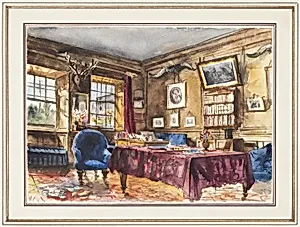
Payne's oeuvre reflects Victorian interests in architecture and landscape, rendered in watercolor, charcoal, black chalk, and etching. His works blend meticulous realism with occasional dramatic flair, as seen in fantastical scenes of ecclesiastical ruin. In the 1870s, he intersected with the avant-garde through James McNeill Whistler, who enlisted framemaker Frederick Fox to instruct Payne on preparing palettes and framing etchings for his studio—hinting at Payne's role in London's artistic circles. By the 1880s, Payne exhibited at prestigious venues like the Grosvenor Gallery and the Royal Institute of Painters in Water Colours, affirming his status among watercolour specialists.
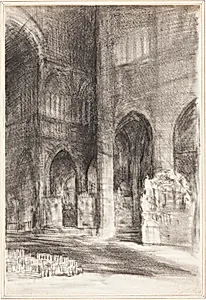
Among his notable pieces are *Eel Pie Island on the Thames from the Top of Twickenham Church* (12 August 1853), a delicate riverside vista; *A View of Oxford from Cowley* (June 1857), annotated with cricket notes; and *Eastbourne from the Chalk Hill near Beachy Head* (11 August 1854). The National Gallery of Art holds striking architectural studies, including *A Cathedral Nave* in charcoal and black chalk, and *An Ecclesiastic Building in Flames with Demons Above* in watercolor over graphite, evoking Gothic sublime. Payne died on 23 July 1910 in Brighton, leaving a modest legacy as a polymath whose topographical precision and atmospheric interiors capture mid-Victorian Britain's picturesque decay and vitality. His works, now surfacing at auction, offer glimpses into an era's overlooked talents.)