
Ctrl K
1828–1901
**August Friedrich Albrecht Schenck (1828–1901)** was a Danish-born painter who spent most of his career in France, becoming renowned for his sensitive depictions of animals—particularly sheep—in evocative landscapes. Born on 23 April 1828 in Glückstadt in the Duchy of Holstein (then under Danish control), Schenck initially pursued a career as a wine merchant, traveling through Germany, Russia, and Portugal before settling in Paris around 1850 to dedicate himself to art.
He trained under the academic painter Léon Cogniet at the École des Beaux-Arts and made his public debut at the 1855 Paris World Exhibition. Schenck quickly gained recognition for his realist animal paintings, often compared to those of Rosa Bonheur, and became a leading figure in the artist colony at Écouen, north of Paris, where he settled permanently with his wife, Ludowika Stapaczinska, around 1862. His works combined precise observation of nature with emotional depth, frequently portraying sheep in dramatic or poignant scenarios that evoked themes of loss, protection, and resilience.
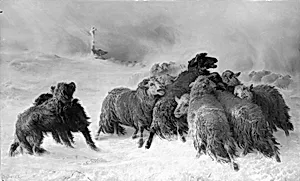
Among his most celebrated paintings is *Anguish* (1878), an oil-on-canvas depicting a grieving ewe standing over her dead lamb, encircled by menacing crows; it was acquired by the National Gallery of Victoria in Melbourne in 1880 and remains one of his best-known works. Another notable piece, *Lost*, showing a flock of sheep huddled in a blizzard near a cross, is held by the Metropolitan Museum of Art. Schenck received further honors when he was made a knight of the Legion of Honour in 1885.
Schenck died in Écouen on 1 January 1901. His legacy endures through museum collections worldwide and local tributes in Écouen, including a street named Rue Auguste Schenck and paintings preserved in the town hall and church. Though his fame has fluctuated, his compassionate portrayals of animals continue to resonate with viewers for their blend of realism and quiet pathos.