Ctrl K
1862–1911
Auguste Donnay (1862-1921) was a Belgian painter, draftsman, and poster artist who became one of the defining figures of the Liège art scene during the Belle Époque, playing a crucial role in the development of Art Nouveau graphic design in Belgium. Born in Liège, the industrial heart of Wallonia, Donnay combined his skills as a painter of regional landscapes with his talents as a poster designer, creating works that promoted both commercial products and cultural events while expressing a distinctively Walloon artistic identity. Donnay is best remembered as one of the three principal poster artists of the Liège school, working alongside Armand Rassenfosse and Émile Berchmans in collaboration with printer Auguste Bénard. Together, they created a body of graphic work that stood at the forefront of European poster art during the late nineteenth and early twentieth centuries. His stylistic range encompassed academic precision, Symbolist mystery, Japanese-influenced compositions, ex-libris designs, and Art Nouveau decorative posters, demonstrating remarkable versatility while maintaining a commitment to expressing regional Walloon character.
Auguste Donnay was born in 1862 in Liège, Belgium, during a period of rapid industrial expansion that transformed the city into one of Europe's major manufacturing centers. Growing up in this environment of technological innovation and industrial prosperity, Donnay witnessed the emergence of modern urban life that would inform his later work.
Donnay received his artistic education at the Académie royale des beaux-arts de Liège (Royal Academy of Fine Arts in Liège), one of Belgium's important art schools. His training provided him with solid academic foundations in drawing, composition, and painting techniques.
During his formative years, Donnay was exposed to multiple artistic currents flowing through Belgium: the academic tradition emphasizing technical precision, the emerging Symbolist movement with its emphasis on mystery and suggestion, and the influence of Japanese prints that were revolutionizing European design sensibilities.
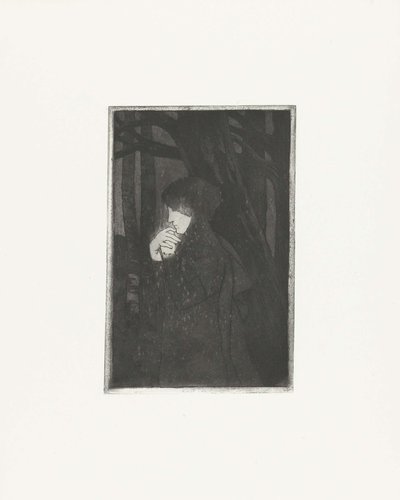
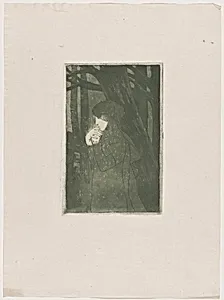
Unlike many artists who specialized narrowly, Donnay developed skills across multiple media and styles. His work would eventually range from academic sketches through Symbolist and Japanese-influenced narrative drawings to decorative compositions, ex-libris designs, and collaborative poster projects.
During the 1890s, Donnay became one of the three main poster designers working for Auguste Bénard's printing press in Liège, alongside Armand Rassenfosse and Émile Berchmans. This collaboration between three talented Liège artists and an innovative French printer created what art historians recognize as the Liège school of poster design.
The partnership stood at the forefront of European poster art during the late nineteenth and early twentieth centuries. Their posters combined sophisticated Art Nouveau aesthetics with advanced printing techniques, achieving visual effects that distinguished Belgian graphic design from its French and German competitors.
One of Donnay's most famous posters was created in 1895 for a contest of choirs (Chant d'Ensemble) held in Liège. This work featured a stylized image exemplifying Art Nouveau's characteristic flowing lines, integration of text and image, and decorative sophistication. The poster's success established Donnay's reputation beyond local circles.
His commercial work demonstrated his ability to synthesize artistic sophistication with effective communication. Unlike some artists who viewed commercial work as inferior to fine art, Donnay approached poster design with the same seriousness and creativity he brought to his paintings.
Parallel to his graphic design work, Donnay maintained an active painting practice focused primarily on landscape. When he painted, he drew frames, colors, and shapes from the landscapes that people of Liège knew well, particularly those of the banks of the Ourthe River, near Mery and Esneux.
These regional landscapes were not merely topographical records but expressions of what Donnay called the "Walloon soul" in painting. In 1905, he wrote on this concept, articulating his belief that the art of French-speaking Belgium should express the particular character, light, and spirit of the Walloon region.
His paintings ranged from oils on canvas to pochades (quick oil sketches on cardboard) that captured the changing effects of weather and season in the Walloon countryside. These works demonstrated his mastery of color and atmosphere, translating the Impressionist interest in light and mood into a specifically regional idiom.
Donnay's commitment to regional subject matter and his theorization of a Walloon artistic identity made him an important figure in the cultural politics of Belgium, where linguistic and regional identities have long shaped artistic movements and institutions.
Donnay served as professor of decorative art at Liège's Académie des Beaux-Arts, the same institution where he had received his own training. In this role, he influenced a generation of Belgian artists, transmitting both technical skills and his philosophy of art's connection to regional identity.
His teaching emphasized the compatibility of fine art and applied design, reflecting his own practice as both painter and graphic artist. This integration of artistic categories anticipated twentieth-century movements like the Bauhaus that would formally unite fine and applied arts.
Throughout his teaching career, Donnay continued producing both paintings and graphic works, demonstrating through example that artists could maintain high standards across multiple disciplines and commercial contexts.
Auguste Donnay died in 1921 in Jette, Belgium. The centenary of his death in 2021 prompted the Liège Museum of Fine Arts (La Boverie) to mount an exhibition of approximately eighty works—including drawings, prints, pochades, and oils on cardboard—drawn from the museum's reserves, introducing his work to new audiences and reassessing his contribution to Belgian art.
Artheon Research Team
Last updated: 2025-11-09
Biography length: ~461 words