Ctrl K
1841–1919
Pierre-Auguste Renoir (1841-1919) was a founding figure of Impressionism whose luminous depictions of Parisian leisure, sensuous female forms, and sun-dappled landscapes made him one of the most beloved painters in Western art history. Born in Limoges to a working-class family, Renoir began as a porcelain painter before pursuing fine arts, and this early craft experience gave him facility with the light, fresh colors that would distinguish his mature work. At Charles Gleyre's studio in Paris, Renoir befriended Claude Monet, Alfred Sisley, and Frédéric Bazille—future co-founders of Impressionism. His collaborative painting sessions with Monet at La Grenouillère in 1869 produced breakthrough works that established the characteristic Impressionist technique of loose brushwork capturing light on water. He exhibited in the first Impressionist exhibition in 1874 and remained central to the movement throughout the 1870s. Unlike some Impressionists who focused on landscape, Renoir was primarily a figure painter, celebrating the beauty of fashionable Parisian society, the vibrancy of dance halls and boating parties, and the warmth of domestic life. His masterpiece 'Dance at Le Moulin de la Galette' (1876) epitomizes this vision—a sun-dappled garden party alive with movement, conversation, and human connection. A trip to Italy in 1881 prompted a significant evolution. Impressed by Raphael and Renaissance masters, Renoir declared he had 'gone as far as I could with Impressionism' and developed a more classical approach emphasizing line, composition, and solid form. This 'dry' or 'Ingres' period eventually softened into a mature synthesis of Impressionist color with traditional structure. Despite severe rheumatoid arthritis that left him wheelchair-bound with deformed hands in his later years, Renoir continued painting until his death, strapping brushes to his wrists. His joyful vision of human beauty and his integration of modernity with tradition influenced generations of artists including Matisse, Picasso, and Bonnard.
Renoir's artistic formation began with porcelain painting in Limoges, where he learned to work with light, fresh colors and developed the craftsmanship that would characterize his career.
In 1862, he entered the studio of Charles Gleyre in Paris, where he formed lifelong friendships with Claude Monet, Alfred Sisley, and Frédéric Bazille.
His early work combined academic training with study of 18th-century French Rococo masters and Romantic painters at the Louvre. From 1865, he frequently painted his lover Lise Tréhot, blending Rococo elegance with Realist naturalism.
The summer of 1869 marked a breakthrough when Renoir painted alongside Monet at La Grenouillère, a boating establishment outside Paris. Their collaborative experiments produced the characteristic Impressionist technique of loose brushstrokes capturing light on rippling water.
Renoir exhibited in the first Impressionist exhibition in 1874, showing 'La Loge,' a celebrated theater scene that demonstrated his mastery of figure painting within the Impressionist idiom.
The late 1870s produced his greatest Impressionist works, including 'Dance at Le Moulin de la Galette' (1876) and 'Luncheon of the Boating Party' (1880-81), both capturing the vitality of Parisian leisure.
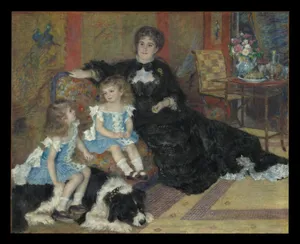
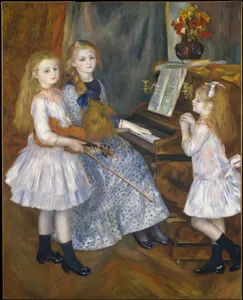
By 1879, success at the official Salon with 'Mme Charpentier and her Children' made Renoir a fashionable portrait painter, though he continued exhibiting with the Impressionists.
A trip to Italy in 1881 transformed Renoir's approach. Seeing works by Raphael, Leonardo, and the Renaissance masters convinced him that pure Impressionism had limitations.
He declared, 'I had gone as far as I could with Impressionism and I realized I could neither paint nor draw.' For the next several years, he pursued a more severe, classical style emphasizing line and solid form.
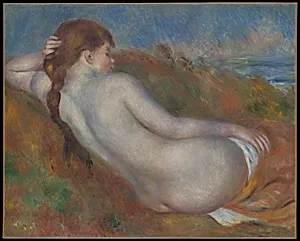
'The Large Bathers' (1884-87), on which he labored for three years, exemplifies this period—monumental nude figures with defined contours that recall Ingres and Renaissance precedents.
This period, sometimes called his 'Ingres style' or 'dry manner,' gradually softened as he reintegrated Impressionist color with classical structure.
Renoir's mature synthesis combined Impressionist luminosity with classical solidity, producing increasingly warm, sculptural paintings with glowing flesh tones.
Severe rheumatoid arthritis progressively limited his mobility from the 1890s, eventually confining him to a wheelchair with permanently deformed hands. Undeterred, he strapped brushes to his wrists and continued working.
From 1913, collaborating with sculptor Richard Guino, he directed the creation of sculptural works that translated his painterly vision into three dimensions.
He spent his final years in Cagnes-sur-Mer in the south of France, painting until just hours before his death in December 1919, having produced over 4,000 works during his lifetime.