
Ctrl K
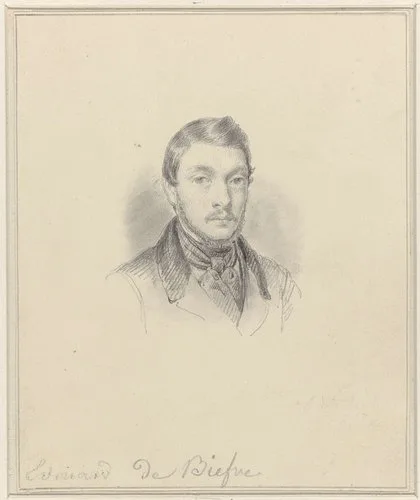
1808–1882
Occupations
Édouard De Bièfve (1808-1882) was a Belgian history and portrait painter who became one of the leading representatives of the Romantic movement in Belgium and exerted significant influence on the development of history painting in Germany. Born in Brussels during the French occupation of the Southern Netherlands, De Bièfve came of age as Belgium achieved independence in 1830, and his monumental history paintings celebrating pivotal moments in Belgian history became visual expressions of emergent Belgian national identity. De Bièfve is best remembered for his massive canvas The Compromise of the Nobles (1841), which depicts the 1566 moment when members of the lesser nobility petition the Spanish Regent Margaret of Parma to moderate religious persecution. This painting, exhibited alongside Louis Gallait's The Abdication of Charles V, achieved extraordinary success across Europe, particularly in Germany where both works provided crucial impetus for the development of a German school of history painting. De Bièfve's commitment to Belgian art extended beyond his death: he bequeathed all the paintings in his studio plus funds for a magnificent tomb monument to the Belgian state.
Édouard De Bièfve was born on December 4, 1808, in Brussels, which was then part of the French Empire under Napoleon Bonaparte. Growing up during the final years of French rule and the subsequent incorporation into the United Kingdom of the Netherlands (1815-1830), De Bièfve experienced firsthand the political transformations that would culminate in Belgian independence.
De Bièfve belonged to the first wave of Belgian Romantic painters who typically trained in Paris, where they encountered the developing Romantic movement that was challenging Neoclassical academic conventions. In Paris, artists like Eugène Delacroix and Théodore Géricault were creating history paintings that emphasized emotional intensity, dramatic compositions, and contemporary or recent historical subjects rather than classical themes.
This Parisian training exposed De Bièfve to new possibilities for history painting: rather than depicting Greek and Roman subjects as academic tradition demanded, Romantic history painters could address national history, creating works that served patriotic and nation-building purposes while demonstrating artistic ambition and technical skill.
De Bièfve returned to the newly independent Belgium (which achieved independence from the Netherlands in 1830) with both artistic training and a mission: to create visual expressions of Belgian national identity through monumental history paintings celebrating key moments in the nation's past.
De Bièfve and fellow Belgian Romantic painters chose as subject matter important historical events regarded as foundational to Belgian national identity. The new Belgian state, seeking to establish legitimacy and cultural distinctiveness from its Dutch and French neighbors, actively supported history painting that celebrated Belgian historical moments.
De Bièfve painted history paintings on unusually large canvases, a scale necessary for public commissions intended for government buildings, museums, and exhibition halls. These monumental works required not only artistic skill but also organizational abilities, financial support, and physical facilities capable of accommodating such large productions.
His subjects emphasized moments when Belgians (or their historical predecessors in the Low Countries) had resisted foreign domination or asserted autonomy—themes that resonated with the newly independent nation that had just separated from Dutch rule and was defining itself against both Dutch and French political and cultural influence.
This nationalist approach to history painting paralleled developments across Europe, where emerging or recently unified nations commissioned artists to create visual narratives of national greatness, suffering, and triumph that would forge collective identity and legitimize new political arrangements.
De Bièfve's masterpiece, The Compromise of the Nobles, depicts the moment on April 5, 1566, when members of the lesser nobility in the Spanish Netherlands concluded a local covenant (the 'Compromise') to petition Regent Margaret of Parma to moderate the repression of religious dissent. This event was crucial in the lead-up to the Dutch Revolt against Spanish rule.
The painting was commissioned by the Belgian government, which actively supported monumental history paintings as part of nation-building efforts. The commission provided financial support and guaranteed prestigious display, while also directing artistic production toward officially sanctioned historical narratives.
The Compromise of the Nobles was exhibited in 1841 together with The Abdication of Charles V by Louis Gallait, also commissioned by the Belgian government. Both paintings depicted crucial moments from Netherlandish history under Spanish Habsburg rule, addressing themes of autonomy, resistance, and political negotiation relevant to Belgian self-understanding.
The paired exhibition of these two monumental Belgian Romantic history paintings achieved extraordinary success. Critics praised both works, and they were exhibited in numerous European cities, bringing Belgian art to international attention and establishing the Belgian Romantic school as significant beyond national borders.
The paintings enjoyed particularly enthusiastic reception in Germany, where they formed an important impetus for the development of a German school of history painting. German critics and artists, observing Belgian success in creating monumental national history paintings, saw models for their own emerging nationalist artistic projects.
This German influence represented De Bièfve's most significant international impact: his work helped inspire the development of German history painting that would flourish in the mid-nineteenth century, contributing to visual expressions of German nationalism during the period leading to German unification (1871).
Throughout his later career, De Bièfve continued producing history and portrait paintings while enjoying recognition as one of Belgium's leading artists. His success reflected the Belgian state's continued support for monumental history painting as expression of national identity.
Édouard De Bièfve died in Brussels on February 7, 1882. In a remarkable gesture demonstrating his commitment to Belgian art, he bequeathed to the Belgian state all the paintings remaining in his studio together with a sum of money designated for the erection of a magnificent tomb monument. This legacy ensured both the preservation of his artistic output and the creation of a fitting memorial. His elaborate tomb can be visited at the cemetery of Laeken in Brussels, serving as a permanent monument to one of Belgium's most important Romantic painters and his contribution to the visual culture of Belgian nationalism.
Artheon Research Team
Last updated: 2025-11-09
Biography length: ~462 words
Wikidata (CC0); Getty ULAN (ODC-By)
