Ctrl K
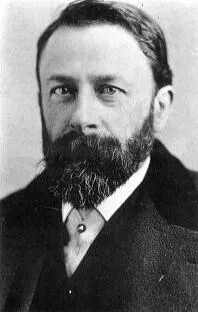
1830–1902
Movements
Occupations
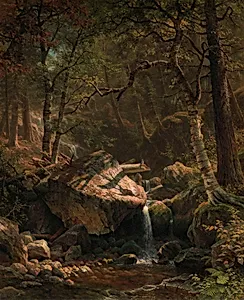
Albert Bierstadt (1830-1902) was a German-American landscape painter renowned for his monumental, luminous depictions of the American West. As a prominent member of the second generation of the Hudson River School and the Rocky Mountain School, Bierstadt created sweeping panoramas that captured the sublime grandeur of untamed wilderness with unprecedented theatrical scale and romantic vision. His training in the Düsseldorf School tradition, combined with innovative use of photography and plein air sketching, enabled him to produce meticulously detailed canvases suffused with ethereal light effects characteristic of American Luminism. Though his grand manner fell from favor as French Impressionism rose to prominence in the late 19th century, Bierstadt's majestic landscapes played a crucial role in shaping the American perception of the western frontier and contributed significantly to the early conservation movement, ultimately helping establish Yellowstone National Park. His work represents the apogee of 19th-century American landscape painting, blending European academic technique with uniquely American subject matter to create an enduring visual mythology of the West.
Born January 7, 1830, in Solingen, Rhine Province, Prussia, to Christina M. Tillmans and Henry Bierstadt, a cooper. When Albert was just one year old, his family emigrated to New Bedford, Massachusetts, seeking new opportunities in America.
Though largely self-taught, Bierstadt displayed artistic talent from youth, making clever crayon sketches. By age twenty, he began offering drawing lessons in New Bedford. In 1851, he started painting in oils, and by 1853 had exhibited at the Massachusetts Academy of Fine Arts.
In 1853, Bierstadt traveled to northern Europe to study at the prestigious Düsseldorf Academy. Though not formally accepted as a student, he worked and studied within the artistic community there from 1853 to 1857, learning plein air techniques under the mentorship of German-American history painter Emanuel Leutze and American landscape painter Worthington Whittredge.
The Düsseldorf School, led by Andreas Achenbach, Karl Friedrich Lessing, Johann Wilhelm Schirmer, and Hans Fredrik Gude, emphasized meticulous attention to detail, hard linearism, and precise depiction of light—techniques that would define Bierstadt's mature style. He befriended fellow American artists including T. Worthington Whittredge, William Stanley Haseltine, and Sanford Robinson Gifford.
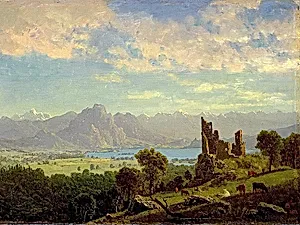
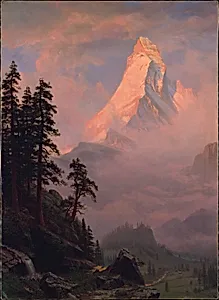
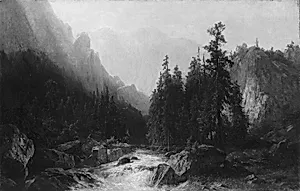
During his European years, Bierstadt traveled extensively, executing sketches of European scenery ranging from the mountainous Swiss Alps to the beaches of the Amalfi Coast. This Alpine experience would later inform his dramatic compositional approach to American mountain landscapes.
Returning to America in 1857, Bierstadt established himself in New York and joined the second generation of the Hudson River School, an informal group of landscape painters creating carefully detailed works with romantic, glowing lighting effects known as Luminism.
In 1859, Bierstadt made his first transformative journey westward, traveling with Frederick W. Lander, a U.S. government land surveyor. This expedition exposed him to the dramatic landscapes of the Rocky Mountains, providing sketches and photographs that would fuel his imagination for years.
He established a studio at the prestigious Tenth Street Studio Building in New York, where he created large-scale exhibition paintings from his western sketches. In 1860, he was elected a member of the National Academy of Design, cementing his professional standing.
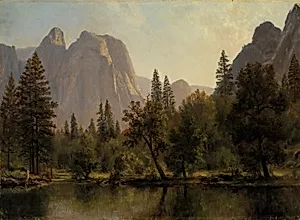
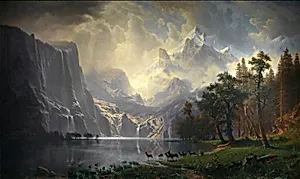
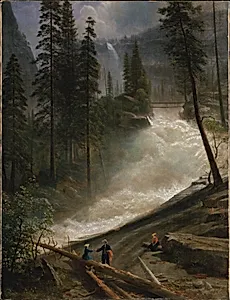
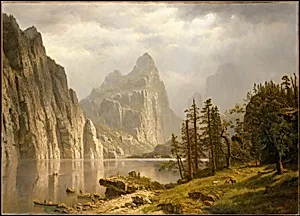
The year 1863 marked a second western journey with author Fitz Hugh Ludlow, spending seven weeks in Yosemite Valley. This trip provided source material for numerous monumental canvases celebrating the Sierra Nevada's grandeur.
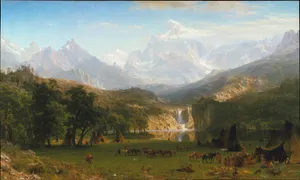
Bierstadt's breakthrough came in 1864 when 'The Rocky Mountains, Lander's Peak' was exhibited at the New York City Sanitary Fair. The painting caused an immediate sensation, bringing international fame to the 34-year-old artist. It sold for the astounding sum of $25,000 (nearly $400,000 in today's currency), establishing Bierstadt as America's most commercially successful landscape painter.
International recognition followed swiftly. In 1867, Bierstadt was presented to Queen Victoria and awarded the Legion of Honor by Napoleon III. He also received the Order of Stanislaus from the Czar of Russia and medals from Austria, Bavaria, Belgium, and Germany.
In 1866, shortly after his father's death, Bierstadt married Rosalie Ludlow, his traveling companion's former wife, and completed construction of Malkasten, an elaborate summer residence and studio overlooking the Hudson River at Irvington-on-Hudson, New York. Throughout the 1860s, he commanded remarkable prices for his paintings, representing the pinnacle of his career.
During the 1870s and 1880s, Bierstadt continued producing magnificent western landscapes, though artistic tastes were beginning to shift. He made additional trips to the American West, constantly seeking fresh subjects and refining his vision of the frontier.
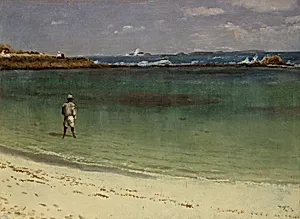
When his wife Rosalie developed tuberculosis, they traveled to the Bahamas, where Bierstadt painted tropical subjects. Tragedy struck when a fire destroyed his studio, consuming many paintings along with a collection of engravings and gifts from General Sheridan, General Custer, and other Army officers from his western travels.
Rosalie passed away in 1893, and the following year Bierstadt married Mary Hicks Stewart, a wealthy widow, before returning permanently to New York. Despite personal losses, he remained professionally active, completing numerous commissions.
However, Bierstadt increasingly found himself fighting a losing battle against changing artistic fashions. The academic style of the Düsseldorf School was falling out of favor, overshadowed by the rising popularity of French Impressionism and the Barbizon School. Critics began dismissing his grand panoramas as theatrical and old-fashioned.
His meticulously detailed, romanticized vision of the West—once celebrated as the epitome of American landscape painting—was now considered outdated. The very qualities that had made him famous—monumentality, precise detail, theatrical lighting—were suddenly liabilities in an art world embracing looser brushwork and atmospheric effects.
The 1890s proved financially devastating for Bierstadt. Unable to adapt to changing tastes or command his former prices, he filed for bankruptcy in 1895. The artist who had once sold paintings for unprecedented sums found himself struggling financially.
Despite his diminished reputation, Bierstadt remained productive, completing over 500 paintings during his lifetime. He continued painting western subjects, maintaining faith in his artistic vision even as the art establishment turned away from his grand manner style.
On February 18, 1902, Albert Bierstadt died in New York City at age 72, largely forgotten by the art world that had once celebrated him. He was buried at Rural Cemetery in New Bedford, Massachusetts. By the time of his death, the taste for epic landscape painting had long subsided, and his contributions were undervalued.
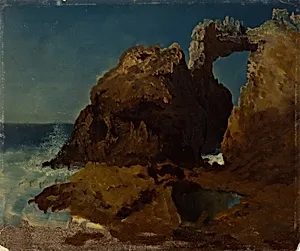
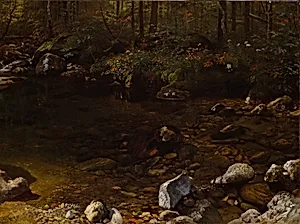
For nearly sixty years, Bierstadt's work remained in relative obscurity. The turning point came in the 1960s with exhibitions of his small oil studies, which revealed the spontaneity and directness underlying his grand compositions. This sparked a critical reassessment of his contributions to American art.
Modern opinions remain divided. Some critics view his work as gaudy, oversized champions of Manifest Destiny, while others recognize that his sublime landscapes helped create public support for wilderness conservation and the establishment of America's national park system, including Yellowstone.
Bierstadt was posthumously honored when Colorado's Mount Bierstadt was named in his recognition. Today, his works command millions at auction and are treasured in major museums worldwide. He is now recognized as one of the most significant American landscape painters of the 19th century, whose luminous visions of the West shaped how generations of Americans imagined their nation's frontier heritage.
Artheon Research Team
Last updated: 2025-11-28
Biography length: ~1,147 words
Wikidata/Wikimedia Commons