
Ctrl K
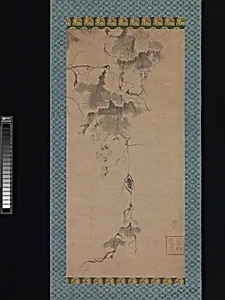
1367–1399
**Bokurin Guan (1367–1399)** was a Japanese Zen monk and ink painter active during the transition from the late Nanbokuchō period (1336–1392) to the early Muromachi period (1392–1573). Little is documented about his personal life beyond his monastic vocation and artistic output, but records identify him as a figure of relatively minor status within Zen circles who nevertheless demonstrated refined skill in monochrome ink painting.
Guan worked in the established tradition of Zen-inspired ink painting that flourished in Japan during this era, emphasizing lyrical depictions of nature with graceful brushwork and precise observation of detail. His sole widely recognized work, the hanging scroll *Cicada on a Grapevine* (ink on paper, approximately 64.2 × 30.8 cm), dates to around 1392–1399 and exemplifies these qualities. The composition captures the end of summer with withered grapevine leaves, ripe fruit, and a solitary cicada clinging to the vine, evoking themes of fecundity and the passage of time. It was originally paired with a complementary painting now held at Kyoto’s Honpōji temple.
As a Zen practitioner, Guan’s art reflects the meditative and naturalistic sensibilities promoted in Muromachi-period monasteries, where ink painting served both devotional and aesthetic purposes. Though biographical details remain sparse, his controlled handling of the brush suggests formal training in the medium. Today, *Cicada on a Grapevine*—acquired by the Metropolitan Museum of Art through the Mary and Jackson Burke Collection—stands as the primary testament to his contribution, preserving a delicate moment of seasonal transition within the broader canon of Japanese ink painting.
Guan’s legacy endures through this singular surviving masterpiece, which continues to illustrate the intimate connection between Zen spirituality and the natural world in late fourteenth-century Japanese art. His work offers modern viewers a window into the refined, contemplative aesthetic of the early Muromachi era.