Ctrl K

1703–1770
Movements
Occupations
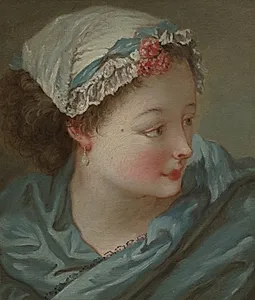
François Boucher (1703–1770) stands as the quintessential master of French Rococo painting and the most celebrated decorative artist of the 18th century. Born in Paris to a lace designer, Boucher created a visual language that perfectly embodied the refined taste, sensuality, and elegance of Louis XV's court. His prolific output—encompassing paintings, tapestry designs, theatrical sets, and decorative arts—shaped the aesthetic identity of an entire era. The Goncourt brothers famously wrote that 'Boucher is one of those men who represent the taste of a century, who express, personify and embody it.' Boucher's genius lay in his ability to transform mythological and pastoral subjects into enchanting visions of idealized beauty. His signature high-toned palette favoring blues and pinks, his fluid brushwork creating silken textures, and his masterful handling of the female nude established him as both a supreme technician and a visual poet of pleasure. As favorite artist to Madame de Pompadour and first painter to Louis XV, he wielded enormous influence over French artistic production through his roles at the Royal Academy, the Gobelins tapestry manufactory, and the Sèvres porcelain works. Though criticized by Enlightenment thinkers like Denis Diderot for lacking 'truth,' Boucher's technical brilliance, decorative inventiveness, and ability to capture the spirit of his age ensured his lasting legacy. His workshop trained the next generation of French painters, most notably Jean-Honoré Fragonard, and his influence extended far beyond France to define Rococo as an international style. Today, his work provides invaluable insight into 18th-century aristocratic culture and represents the apex of Rococo achievement.
Born September 29, 1703, in Paris, François Boucher was the son of Nicolas Boucher (1672–1743), a member of the Académie de Saint-Luc and a lace designer. This early exposure to decorative arts would profoundly influence his approach to composition and ornament throughout his career.
At age seventeen, Boucher's talent attracted the attention of François Lemoyne (1688–1737), one of the leading history painters of the day. Though he apprenticed with Lemoyne for only three months, he absorbed crucial lessons in dramatic composition and color. He then worked with the engraver Jean-François Cars, developing technical skills that would serve him throughout his career.
In 1720, Boucher won the prestigious Grand Prix de Rome, but financial difficulties at the Académie royale de peinture et de sculpture delayed his Italian journey until 1727. He spent these intervening years creating engravings after Watteau's works, absorbing the fêtes galantes tradition that would influence his pastoral scenes.
During his Italian sojourn from 1727 to 1731, Boucher studied the works of Giovanni Battista Tiepolo and absorbed Venetian colorism, while also encountering the Baroque dynamism of Peter Paul Rubens. These influences fused with French elegance to create his distinctive mature style.
Returning to Paris around 1731, Boucher turned his attention to large-scale mythological paintings and quickly found official recognition. He married Marie-Jeanne Buzeau in 1733, with whom he would have three children. In 1734, he was received (reçu) into the Royal Academy, launching his meteoric rise through the French artistic establishment.
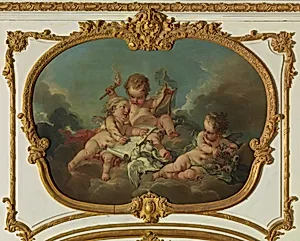
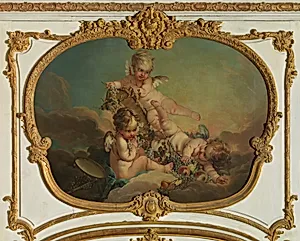
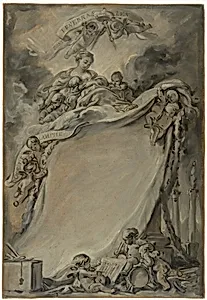
His wide-ranging production soon graced the walls of an equally wide-ranging clientele, from King Louis XV and Swedish ambassador Count Carl Gustav Tessin to bourgeois collectors of more modest means. Boucher's ability to work across media—painting, tapestry design, theatrical sets, book illustration—made him indispensable to aristocratic patrons seeking coordinated decorative schemes.
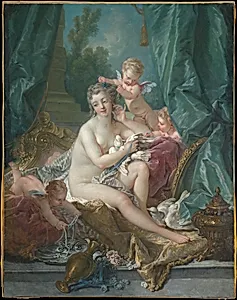
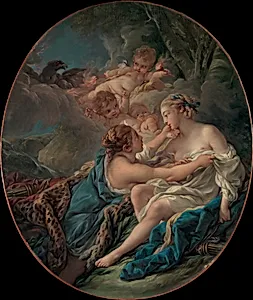
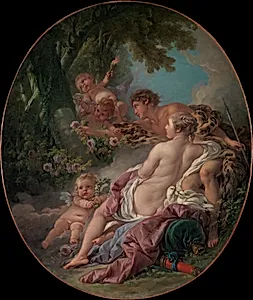
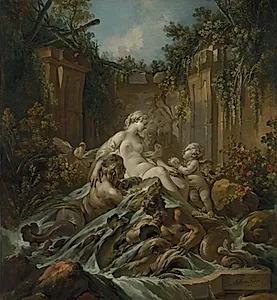
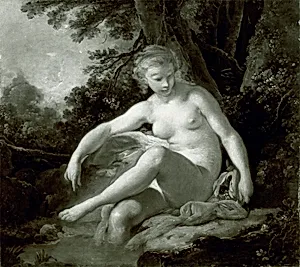
During the 1740s, Boucher produced some of his most celebrated mythological paintings, including 'Diana Leaving Her Bath' (1742), now in the Louvre. This work exemplifies his mature Rococo style with its mythological subject rendered with playful sensuality, cool palette of blues and pinks, and masterful handling of the female nude.
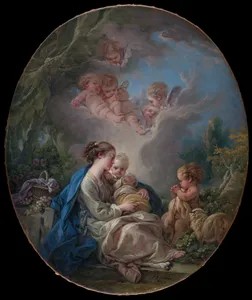
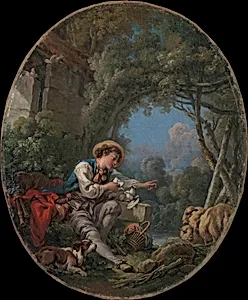
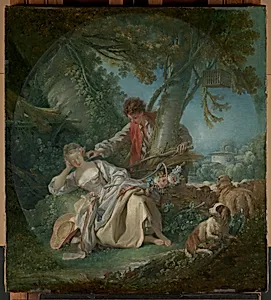
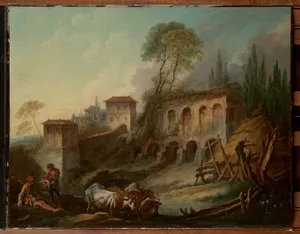
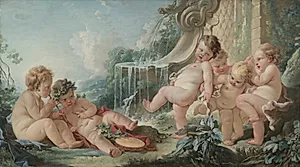
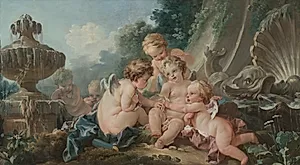
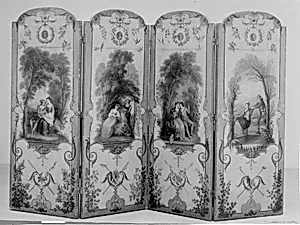
Boucher's most original contribution to Rococo painting emerged in this period: his reinvention of the pastoral. His idealized landscapes populated by shepherds and shepherdesses in silk dress, enacting scenes of erotic and sentimental love, became the defining imagery of French Rococo and were endlessly replicated in paintings, tapestries, and porcelain figurines.
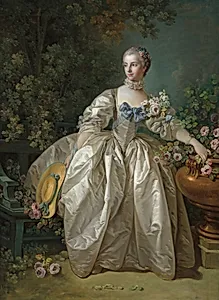
Around 1750, Boucher became the favorite artist of Madame de Pompadour (1721–1764), the chief mistress and later closest adviser to Louis XV. Their shared Parisian background and Boucher's interest in opera and fashion created a natural affinity. Pompadour commissioned numerous works from him, including historical and religious paintings that challenged him to broaden his artistic range.
Between 1750 and 1759, Boucher created a remarkable series of portraits of Madame de Pompadour that showcase their collaborative relationship. These portraits helped maintain her presence at court even as she aged, demonstrating Boucher's ability to flatter while maintaining artistic sophistication.
In 1755, Boucher was appointed head of the royal tapestry manufactory at Gobelins, overseeing the translation of his designs into woven masterpieces. His compositions were perfectly suited to tapestry, with their flat decorative surfaces and interlocking arabesques. Some 1,500 prints after his works circulated throughout Europe, spreading his influence internationally.
Boucher also provided designs for the Sèvres porcelain manufactory, where his gallant shepherds and shepherdesses were replicated as soft-paste biscuit porcelain figurines and as polychrome painted decoration for tableware. His impact on the decorative arts of the Rococo period, in France and throughout Europe, is difficult to overstate.
In 1765, Boucher achieved the pinnacle of official recognition, being appointed to the two highest positions in the French arts establishment: first painter to the king and director of the Royal Academy. These appointments came despite mounting criticism from Enlightenment intellectuals who saw his work as frivolous and morally corrupt.
Denis Diderot, the era's most influential art critic, famously wrote of Boucher in his review of the 1761 Salon: 'Cet homme a tout—excepté la vérité' (That man is capable of everything—except the truth). Diderot and others like Étienne La Font de Saint-Yenne attacked Boucher's lighthearted subject matter and fluid, coloristic style as symptomatic of aristocratic decadence.
Boucher's studio during this period was a training ground for many young artists. The greatest of these was Jean-Honoré Fragonard (1732–1806), who entered Boucher's studio around 1748 and quickly mastered his teacher's style so completely that Boucher entrusted him with executing replicas of his own paintings. Through Fragonard and others, Boucher's influence extended into the next generation.
Despite the critical backlash, Boucher continued working prolifically until his death. He died on May 30, 1770, in his native Paris. By this time, his name, along with that of Madame de Pompadour, had become synonymous with the French Rococo style. He reportedly died at his easel, having remained productive until the very end of his life.
Artheon Research Team
Last updated: 2025-11-28
Biography length: ~1,185 words
Wikidata/Wikimedia Commons