Bruce Nauman, born on December 6, 1941, in Fort Wayne, Indiana, grew up in a family frequently uprooted by his father's career as a General Electric engineer. After studying mathematics, physics, and art at the University of Wisconsin-Madison, where he earned a BS in 1964, Nauman pursued an MFA at the University of California, Davis in 1966. There, he studied under William T. Wiley and Robert Arneson, worked as an assistant to Wayne Thiebaud—who taught him "how to pay attention"—and was influenced by the school's experimental ethos and instructors like Manuel Neri. He also drew unconventional lessons from horse trainer Ray Hunt on focus and process. Abandoning painting after graduation, Nauman dove into sculpture, performance, film, and video in a San Francisco studio, marking his shift to process-oriented experimentation.
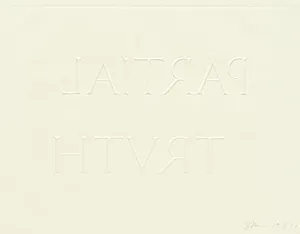
Nauman's oeuvre defies medium, spanning neon, video, installation, and performance in the Post-Minimalist, Process Art, and Conceptual traditions. Worked in the UC Davis funk ceramics and assemblage vein early on, his art probes language's ambiguities—inspired by Wittgenstein—alongside the body's limits, psychological tension, surveillance, and absurdity. Wordplay, puns, and ironic texts animate neon signs, while videos capture repetitive, uncomfortable actions evoking cruelty, games, and existential dread.
Pivotal works include *Self-Portrait as a Fountain* (1966), a photographic performance of spouting water; the neon *The True Artist Helps the World by Revealing Mystic Truths* (1967); early videos like *Art Make-Up* (1967) and *Walk with Contrapposto* (1968); claustrophobic installations such as *Green Light Corridor* (1970); *Clown Torture* (1987), with its looping humiliations; and late masterpieces like *Mapping the Studio I (Fat Chance John Cage)* (2001), chronicling his studio's nocturnal life via multi-projections. He married painter Susan Rothenberg in 1989, sharing a New Mexico ranch until her death in 2020; earlier, with first wife Judy Govan, he had children Erik and Zoë.
Nauman's relentless innovation reshaped contemporary art, earning Golden Lions at the Venice Biennale (1999, 2009), the Wolf Prize (1993), and Praemium Imperiale (2004). Retrospectives at MoMA, Tate Modern, and elsewhere affirm his legacy as a boundary-pusher, influencing generations with his interrogation of human behavior and art's provocative power.