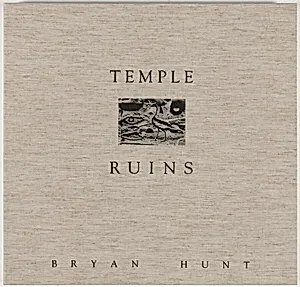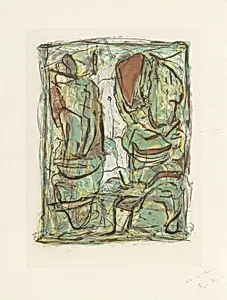
Bryan Hunt (born 1947) is an American sculptor whose elegant, process-oriented works occupy a distinctive place in the landscape of postwar American art. Born in Terre Haute, Indiana, he studied at the Otis Art Institute in Los Angeles before relocating to New York in the early 1970s, where he quickly became part of the dynamic artistic scene that included many of the leading figures of his generation. His early works drew on the Conceptual and minimal impulses of the moment, but Hunt soon developed a more lyrical and formally complex approach that set him apart from the dominant minimalist tendency.
Hunt is best known for his cast bronze sculptures of waterfalls, airships, and lakes — subjects drawn from nature and from early aviation history that he rendered in a manner hovering between abstraction and representation. His waterfall sculptures, produced from the late 1970s onward, are among his most celebrated works: cascading forms in richly patinated bronze that capture the movement and energy of falling water while remaining entirely sculptural objects. The surfaces of these pieces bear the imprint of his working process — the pour and drip and accumulation of material — in ways that emphasize making as an expressive act.
His lake sculptures, by contrast, are horizontal works that evoke still water through thin, translucent sheets of bronze, their surfaces recalling the quality of light on water at rest. Throughout his career, Hunt has demonstrated a fascination with natural forces — gravity, flow, accumulation — and with the tension between the permanence of cast metal and the transience of the phenomena he depicts.
Hunt's work is held in major museum collections across the United States, and he has been recognized with numerous awards and fellowships. His sculpture represents a sustained and compelling investigation of the relationship between natural form, material process, and sculptural tradition — work that bridges the formal concerns of modernism with a deep responsiveness to the physical world.

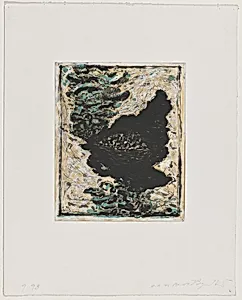
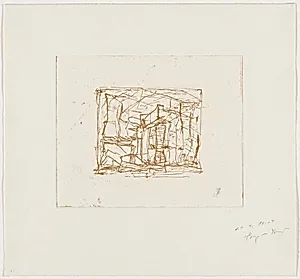
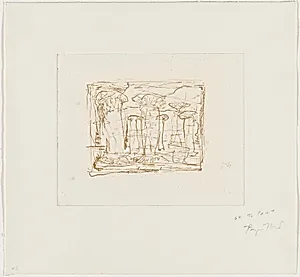
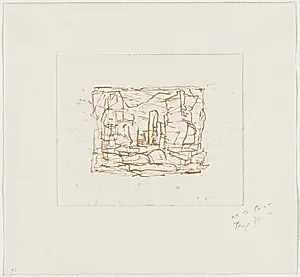
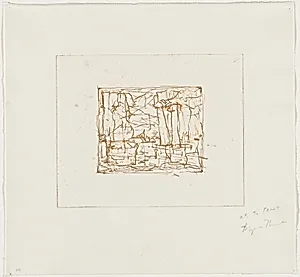
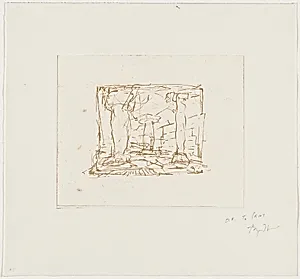
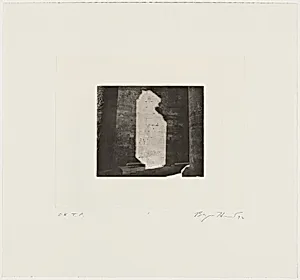
![Cairn 4 [working proof 2]](https://images.artheonmuseum.org/nga/thumb/cairn-4-working-proof-2-nga-230360.webp)
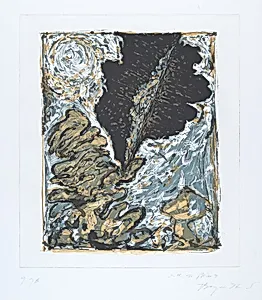
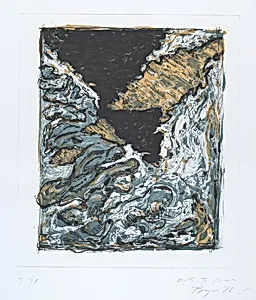
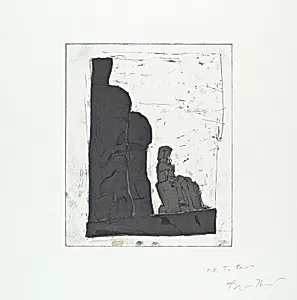
![Cairn 4 [working proof 1]](https://images.artheonmuseum.org/nga/thumb/cairn-4-working-proof-1-nga-230359.webp)
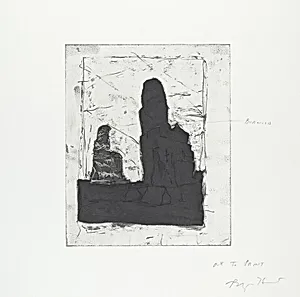
![Cairn 4 [working proof 3]](https://images.artheonmuseum.org/nga/thumb/cairn-4-working-proof-3-nga-230361.webp)